Microbial Ozone Decontamination of N95 Respirators: Efficacy and Material Preservation
DOI:
https://doi.org/10.59796/jcst.V16N1.2026.165Keywords:
germzero3 prototype, ozone decontamination, n95 respiratorsAbstract
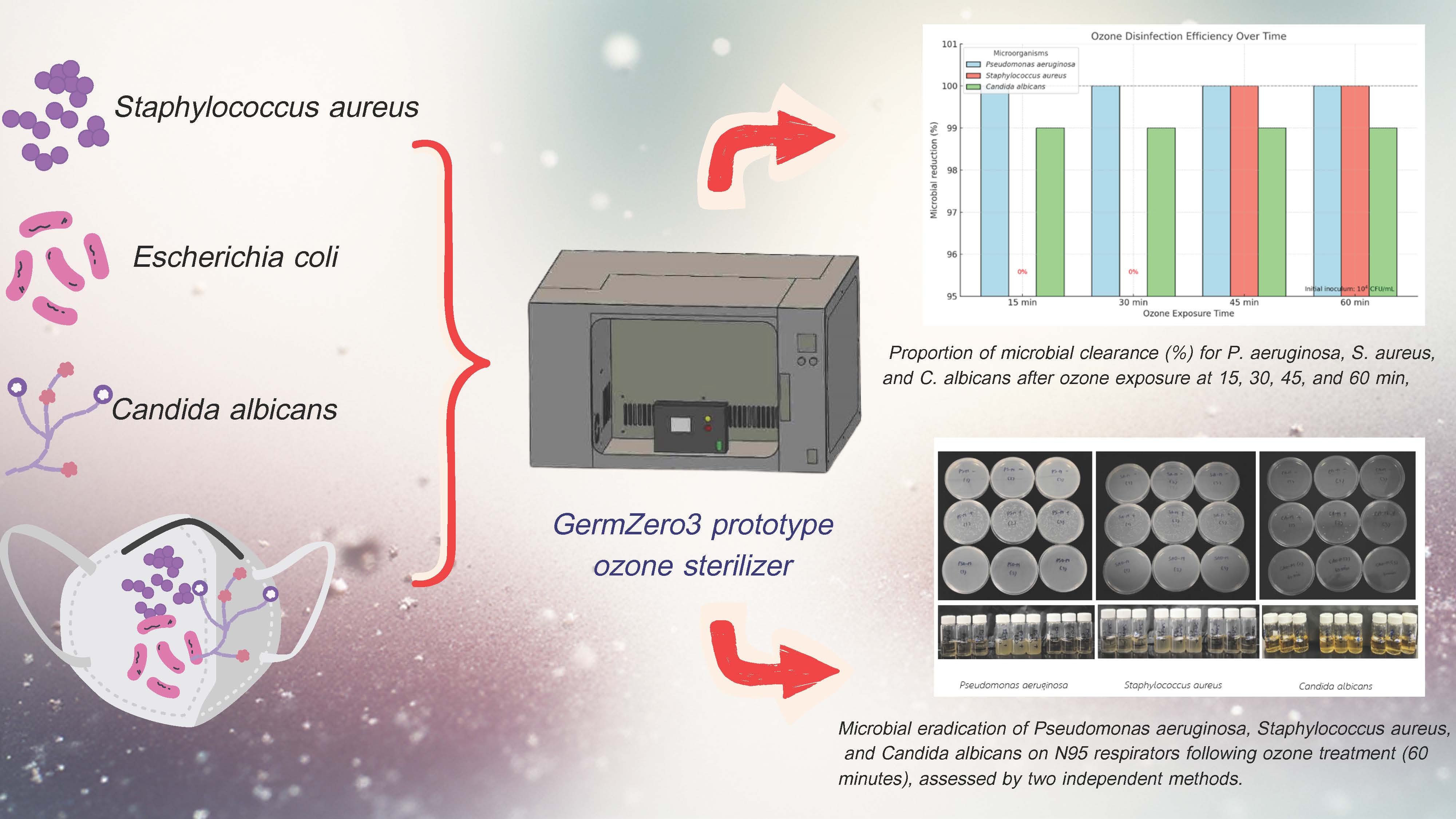
Ozone gas is a promising method for decontaminating personal protective equipment (PPE), providing broad antimicrobial activity with minimal residue effects. However, its effects on the structural integrity and filtration performance of N95 respirators are not well established. This study evaluated the antimicrobial efficacy of ozone treatment against Pseudomonas aeruginosa, Staphylococcus aureus, and Candida albicans on culture media and N95 respirators, and assessed whether fiber integrity and filtration efficiency were preserved using the GermZero3 prototype sterilizer developed with the National Science and Technology Development Agency (NSTDA). Microbial suspensions (10⁴ CFU/mL in TSB broth) were inoculated onto agar plates and respirator sections, and then exposed to 25–50 ppm ozone for 15–60 min. Viability was assessed by culture, while fiber integrity and filtration efficiency were evaluated by scanning electron microscopy and a NaCl aerosol test. Complete eradication of P. aeruginosa was achieved after 15 min and S. aureus within 45 min. C. albicans showed 99.90–99.98% reduction by 45–60 min, with no statistically significant difference from full clearance. When applied to contaminated respirators, ozone treatment eliminated all three pathogens after 60 min. Fiber morphology remained intact, and filtration efficiency was preserved at 99.99%, exceeding the ≥95% N95 standard. These findings support ozone treatment with the GermZero3 sterilizer as a safe and effective method for extending N95 respirator use during shortages.
References
Biabani, A., Rahimi, E., Golbabaei, F., & Ghaljahi, M. (2025). A systematic review of the challenge of quantitative fit coefficient of reprocessed filter respirators: The role of respirator models and disinfection methods. Journal of Industrial Textiles, 55. https://doi.org/10.1177/15280837251350971
Choudhury, B., Lednicky, J. A., Loeb, J. C., Portugal, S., & Roy, S. (2024). Inactivation of SARS CoV-2 on porous and nonporous surfaces by compact portable plasma reactor. Frontiers in Bioengineering and Biotechnology, 12, Article 1325336. https://doi.org/10.3389/fbioe.2024.1325336
Cristiano, L. (2020). Could ozone be an effective disinfection measure against the novel coronavirus (SARS-CoV-2)?. Journal of Preventive Medicine and Hygiene, 61(3), E301–E303.
Del Monte, M., Edwards, A. R., Waldron, D. B., Aird, L. D., Airhart, C. K., Robinson, L. B., … & White, M. L. (2024). Successes and lessons learned in responding to the needs of pediatricians, children, and families during the COVID-19 pandemic. Pediatrics, 153(6), Article e2024066634. https://doi.org/10.1542/peds.2024-066634
Duan, N., Du, J., Huang, C., & Li, H. (2020). Microbial distribution and antibiotic susceptibility of lower respiratory tract infections patients from pediatric ward, adult respiratory ward, and respiratory intensive care unit. Frontiers in Microbiology, 11, Article 1480. https://doi.org/10.3389/fmicb.2020.01480
Epelle, E. I., Emmerson, A., Nekrasova, M., Macfarlane, A., Cusack, M., Burns, A., ... & Yaseen, M. (2022). Microbial inactivation: gaseous or aqueous ozonation?. Industrial & Engineering Chemistry Research, 61(27), 9600-9610. https://doi.org/10.1021/acs.iecr.2c01551
Epelle, E. I., Macfarlane, A., Cusack, M., Burns, A., Okolie, J. A., Mackay, W., ... & Yaseen, M. (2023a). Ozone application in different industries: A review of recent developments. Chemical Engineering Journal, 454, Article 140188. https://doi.org/10.1016/j.cej.2022.140188
Epelle, E. I., Macfarlane, A., Cusack, M., Burns, A., Okolie, J. A., Vichare, P., ... & Yaseen, M. (2023b). Ozone decontamination of medical and nonmedical devices: An assessment of design and implementation considerations. Industrial & Engineering Chemistry Research, 62(10), 4191-4209. https://doi.org/10.1021/acs.iecr.2c03754
Hanyanunt, P., Juntanawiwat, P., Chatreewonanakul, T., Potisuwan, P., Simsiriporn, W., Phondee, S., ... & Boonsiri, T. (2020). Effects of ultraviolet C (uvc) light and dry heat on filtration performance of N95 respirator mask. Journal of Southeast Asian Medical Research, 4(2), 48-52. https://doi.org/10.55374/jseamed.v4i2.75
Hurley, J. (2025). Associations between candida and Staphylococcus aureus, Pseudomonas aeruginosa, and Acinetobacter species as ventilator-associated pneumonia isolates in 84 cohorts of ICU patients. Microorganisms, 13(6), Article 1181. https://doi.org/10.3390/microorganisms13061181
Jain, U. (2020). Risk of COVID-19 due to shortage of personal protective equipment. Cureus, 12(6), Article e8837. https://doi.org/10.7759/cureus.8837
Lam, K. K. K., & Phil, M. (2003). Ozone disinfection of SARS-contaiminated areas. Retrieved from https://www.oxidationtech.com/blog/wp-content/uploads/2020/04/Ozone-Disinfection-of-SARS-contaminated-areas.pdf
Kharbat, A., Mizer, A., & Zumwalt, M. (2020). Decontamination methods of personal protective equipment for repeated utilization in medical/surgical settings. The Southwest Respiratory and Critical Care Chronicles, 8(34), 27-39. https://doi.org/10.12746/swrccc.v8i34.677
Kumar, A., Kasloff, S. B., Cutts, T., Leung, A., Sharma, N., Vazquez-Grande, G., ... & Krishnan, J. (2021). Standard hospital blanket warming cabinets can be utilized for complete moist heat SARS-CoV2 inactivation of contaminated N95 masks for re-use. Scientific Reports, 11(1), Article 18316. https://doi.org/10.1038/s41598-021-97345-w
Manning, E. P., Stephens, M. D., Dufresne, S., Silver, B., Gerbarg, P., Gerbarg, Z., ... & Sharma, L. (2021). Disinfection of Pseudomonas aeruginosa from N95 respirators with ozone: A pilot study. BMJ Open Respiratory Research, 8(1), Article e000781. https://doi.org/10.1136/bmjresp-2020-000781
Moore, G., Griffith, C., & Peters, A. (2000). Bactericidal properties of ozone and its potential application as a terminal disinfectant. Journal of food protection, 63(8), 1100-1106. https://doi.org/10.4315/0362-028X-63.8.1100
Panebianco, F., Rubiola, S., Chiesa, F., Civera, T., & Di Ciccio, P. A. (2022). Effect of gaseous ozone treatment on biofilm of dairy-isolated Pseudomonas spp. strains. Italian Journal of Food Safety, 11(2), Article 10350. https://doi.org/10.4081/ijfs.2022.10350
Rangel, K., Cabral, F. O., Lechuga, G. C., Carvalho, J. P., Villas-Bôas, M. H., Midlej, V., & De-Simone, S. G. (2022). Detrimental effect of ozone on pathogenic bacteria. Microorganisms, 10(1), Article 40. https://doi.org/10.3390/microorganisms10010040
Rutala, W. A., & Weber, D. J. (2004). Disinfection and sterilization in health care facilities: What clinicians need to know. Clinical Infectious Diseases, 39(5), 702-709. https://doi.org/10.1086/423182
Sallustio, F., Cardinale, G., Voccola, S., Picerno, A., Porcaro, P., & Gesualdo, L. (2021). Ozone eliminates novel coronavirus Sars-CoV-2 in mucosal samples. New Microbes and New Infections, 43, Article 100927. https://doi.org/10.1016/j.nmni.2021.100927
Sharma, M., & Hudson, J. B. (2008). Ozone gas is an effective and practical antibacterial agent. American Journal of Infection Control, 36(8), 559-563. https://doi.org/10.1016/j.ajic.2007.10.021
Sharma, S., Wang, F., Kumar, S., Nawal, R. R., Kumar, P., Yadav, S., ... & Rawal, A. (2022). Structural and functional integrity of decontaminated N95 Respirators: Experimental results. Journal of Industrial Textiles, 51(5_suppl), 7999S-8017S. https://doi.org/10.1177/15280837221082322
Santos, L. M. C. D., Silva, E. S. D., Oliveira, F. O., Rodrigues, L. D. A. P., Neves, P. R. F., Meira, C. S., ... & Machado, B. A. S. (2021). Ozonized water in microbial control: analysis of the stability, in vitro biocidal potential, and cytotoxicity. Biology, 10(6), Article 525. https://doi.org/10.3390/biology10060525
Tippayawat, P., Vongnarkpetch, C., Papalee, S., Srijampa, S., Boonmars, T., Meethong, N., & Phanthanawiboon, S. (2022). Disinfection efficiency test for contaminated surgical mask by using Ozone generator. BMC Infectious Diseases, 22(1), Article 234. https://doi.org/10.1186/s12879-022-07227-3
Zhu, J., Jiang, Q., He, X., Li, X., Wang, L., Zheng, L., ... & Chen, M. (2022). Filtration efficiency of N95 filtering facepiece respirators during multi-cycles of ‘8-hour simulated donning+ disinfection’. Journal of Hospital Infection, 127, 91-100. https://doi.org/10.1016/j.jhin.2022.06.016
Downloads
Published
How to Cite
Issue
Section
Categories
License
Copyright (c) 2025 Journal of Current Science and Technology

This work is licensed under a Creative Commons Attribution-NonCommercial-NoDerivatives 4.0 International License.