Effect of Magnetic Field on Heat Transfer Enhancement and Pressure Drop of Fluid Flow with Magnetic Particle Suspension in a Curled Pipe
DOI:
https://doi.org/10.59796/jcst.V16N2.2026.169Keywords:
heat transfer enhancement, pressure drop, magnetic field, gamma-type iron oxides, surface heat flux, curve ratioAbstract
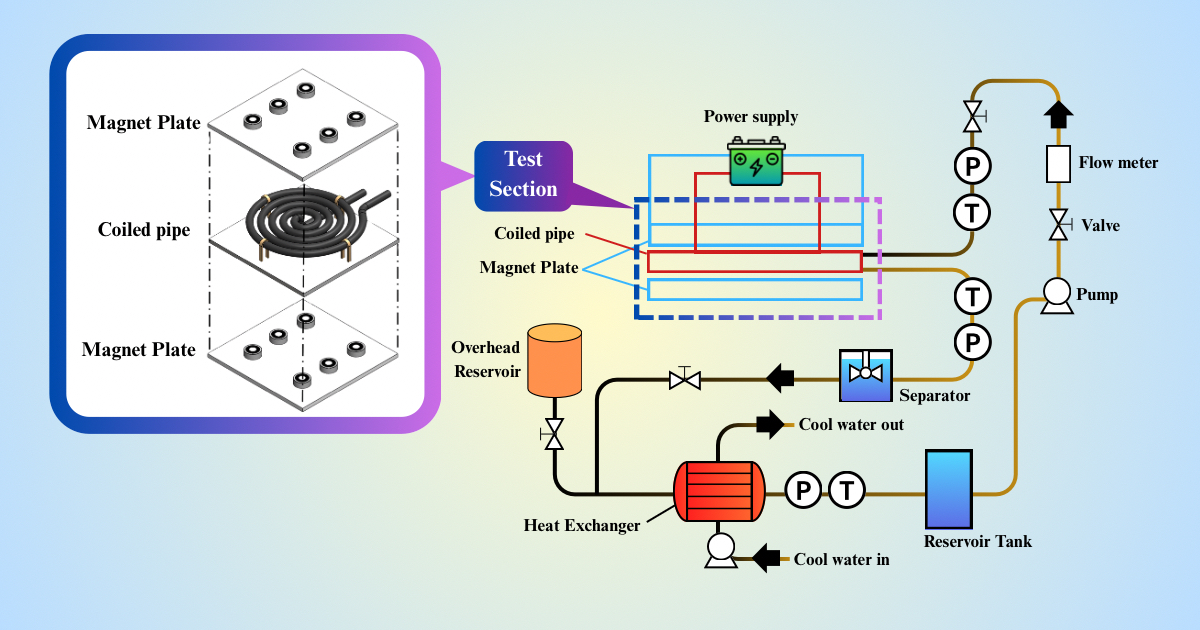
The characteristics of heat transfer enhancement and pressure drop in the curled pipe under the effect of a magnetic field are presented in this paper. The suspensions, which are composed of -Fe2O3 (gamma-phase iron oxide) magnetic particles with a median diameter of 15–20 nm dispersed in plain water have been used. The magnetic particles at different concentrations by volume of 0.50%, 0.75% and 1.00% were used in the pipe flow experiments. The suspension enters the curled pipe at the innermost turn, flows under a uniform surface heat flux, and exits at the outermost turn. To increase the rate of heat transfer, three different strengths of an external magnetic field of 600 Gauss (G), 1,200 G, and 1,800 G were utilized by the electromagnets mounted on plates located at the top and bottom of the curled pipe. The effects of magnetic field strength, concentration by volume of magnetic particles, and curve ratios on the heat transfer enhancement and pressure drop are shown. The results show that the Nusselt number increases with increasing magnetic field strength, particle volume concentration, and curve ratio. The Nusselt number increased by up to 14.34%, 19.19%, and 26.26% for magnetic field strengths of 600 G, 1,200 G, and 1,800 G, respectively.
References
Abdullah, M. S., & Hussein, A. M. (2023). Experimental and numerical investigations on the heat transfer of a helical coil heat exchanger utilized α-Al2O3 nanofluid. Diyala Journal of Engineering Sciences, 16(3), 64–81. https://doi.org/10.24237/djes.2023.16306
Arabpour, A., Karimipour, A., & Toghraie, D. (2018). The study of heat transfer and laminar flow of kerosene/multi-walled carbon nanotubes (MWCNTs) nanofluid in the microchannel heat sink with slip boundary condition. Journal of Thermal Analysis and Calorimetry, 131(2), 1553-1566. https://doi.org/10.1007/s10973-017-6649-x
Bahiraei, M., & Hangi, M. (2015). Flow and heat transfer characteristics of magnetic nanofluids: A review. Journal of Magnetism and Magnetic Materials, 374, 125-138. https://doi.org/10.1016/j.jmmm.2014.08.004
Drew, D. A., & Passman, S. L. (1999). Theory of multicomponent fluids. Springer Science & Business Media.
Esfe, M. H., Raki, H. R., Emami, M. R. S., & Afrand, M. (2019). Viscosity and rheological properties of antifreeze based nanofluid containing hybrid nano-powders of MWCNTs and TiO2 under different temperature conditions. Powder Technology, 342, 808-816. https://doi.org/10.1016/j.powtec.2018.10.032
Ghaderi, A., Veysi, F., Aminian, S., Andami, Z., & Najafi, M. (2022). Experimental and numerical study of thermal efficiency of helically coiled tube heat exchanger using ethylene glycol-distilled water based Fe3O4 nanofluid. International Journal of Thermophysics, 43(8), Article 118. https://doi.org/10.1007/s10765-022-03041-w
Hayat, T., Tanveer, A., Alsaadi, F., & Mousa, G. (2016). Impact of radial magnetic field on peristalsis in curved channel with convective boundary conditions. Journal of Magnetism and Magnetic Materials, 403, 47-59. https://doi.org/10.1016/j.jmmm.2015.11.078
Hojjat, M., Etemad, S. G., Bagheri, R., & Thibault, J. (2011). Thermal conductivity of non-Newtonian nanofluids: Experimental data and modeling using neural network. International Journal of Heat and Mass Transfer, 54(5-6), 1017-1023. https://doi.org/10.1016/j.ijheatmasstransfer.2010.11.039
Hoque, M. M., & Alam, M. M. (2013). Effects of Dean number and curvature on fluid flow through a curved pipe with magnetic field. Procedia Engineering, 56, 245-253. https://doi.org/10.1016/j.proeng.2013.03.114
Jeong, J., Li, C., Kwon, Y., Lee, J., Kim, S. H., & Yun, R. (2013). Particle shape effect on the viscosity and thermal conductivity of ZnO nanofluids. International Journal of Refrigeration, 36(8), 2233-2241. https://doi.org/10.1016/j.ijrefrig.2013.07.024
Karimi, A., Goharkhah, M., Ashjaee, M., & Shafii, M. B. (2015). Thermal conductivity of Fe2O3 and Fe3O4 magnetic nanofluids under the influence of magnetic field. International Journal of Thermophysics, 36(10), 2720-2739. https://doi.org/10.1007/s10765-015-1977-1
Keyvani, M., Afrand, M., Toghraie, D., & Reiszadeh, M. (2018). An experimental study on the thermal conductivity of cerium oxide/ethylene glycol nanofluid: Developing a new correlation. Journal of Molecular Liquids, 266, 211-217. https://doi.org/10.1016/j.molliq.2018.06.010
Khodadadi, H., Toghraie, D., & Karimipour, A. (2019). Effects of nanoparticles to present a statistical model for the viscosity of MgO-Water nanofluid. Powder Technology, 342, 166-180. https://doi.org/10.1016/j.powtec.2018.09.076
Liou, T. M., Wei, T. C., & Wang, C. S. (2019). Investigation of nanofluids on heat transfer enhancement in a louvered microchannel with lattice Boltzmann method. Journal of Thermal Analysis and Calorimetry, 135(1), 751-762. https://doi.org/10.1007/s10973-018-7299-3
Noreen, S., Qasim, M., & Khan, Z. H. (2015). MHD pressure driven flow of nanofluid in curved channel. Journal of Magnetism and Magnetic Materials, 393, 490-497. https://doi.org/10.1016/j.jmmm.2015.05.038
Pak, B. C., & Cho, Y. I. (1998). Hydrodynamic and heat transfer study of dispersed fluids with submicron metallic oxide particles. Experimental Heat Transfer an International Journal, 11(2), 151-170. https://doi.org/10.1080/08916159808946559
Pakdaman, M. F., Akhavan-Behabadi, M. A., & Razi, P. (2012). An experimental investigation on thermo-physical properties and overall performance of MWCNT/heat transfer oil nanofluid flow inside vertical helically coiled tubes. Experimental Thermal and Fluid Science, 40, 103-111. https://doi.org/10.1016/j.expthermflusci.2012.02.005
Rosensweig, R. E. (2013). Ferrohydrodynamics. Courier Corporation. Retrieved from https://books.google.mw/books?id=ng_DAgAAQBAJ&printsec=frontcover#v=onepage&q&f=false
Shabi, O. A., Alhazmy, M., Negeed, E. S. R., & Elzoghaly, K. O. (2024). Experimental investigation of shell and helical coiled heat exchanger with Al2O3 nano-fluid with wide range of particle concentration. Frontiers in Mechanical Engineering, 10, Article 1386254. https://doi.org/10.3389/fmech.2024.1386254
Varkaneh, A. S., Nooshabadı, G. A. S., & Arani, A. A. A. (2023). Flow field and heat transfer of ferromagnetic nanofluid in presence of magnetic field inside a corrugated tube. Journal of Thermal Engineering, 9(6), 1667-1686. https://doi.org/10.18186/thermal.1401685
Wu, Z., Wang, L., & Sundén, B. (2013). Pressure drop and convective heat transfer of water and nanofluids in a double-pipe helical heat exchanger. Applied Thermal Engineering, 60(1-2), 266-274. https://doi.org/10.1016/j.applthermaleng.2013.06.051
Xin, R. C., & Ebadian, M. A. (1997). The effects of Prandtl numbers on local and average convective heat transfer characteristics in helical pipes. Journal of Heat Transfer, 119(3), 467–473. https://doi.org/10.1115/1.2824120
Xuan, Y., & Roetzel, W. (2000). Conceptions for heat transfer correlation of nanofluids. International Journal of Heat and Mass Transfer, 43(19), 3701-3707. https://doi.org/10.1016/S0017-9310(99)00369-5
Yarahmadi, M., Goudarzi, H. M., & Shafii, M. B. (2015). Experimental investigation into laminar forced convective heat transfer of ferrofluids under constant and oscillating magnetic field with different magnetic field arrangements and oscillation modes. Experimental Thermal and Fluid Science, 68, 601-611. https://doi.org/10.1016/j.expthermflusci.2015.07.002
Downloads
Published
How to Cite
Issue
Section
Categories
License
Copyright (c) 2026 Journal of Current Science and Technology

This work is licensed under a Creative Commons Attribution-NonCommercial-NoDerivatives 4.0 International License.