Waste Heat Recovery from Biomass Charcoal Cookstoves via Elliptical-Tube Helical Coils: Application in a Medium Sized Thai Restaurant
DOI:
https://doi.org/10.59796/jcst.V16N3.2026.188Keywords:
biomass cookstove, waste heat recovery, CFD, economic evaluation, sustainable restaurant operationAbstract
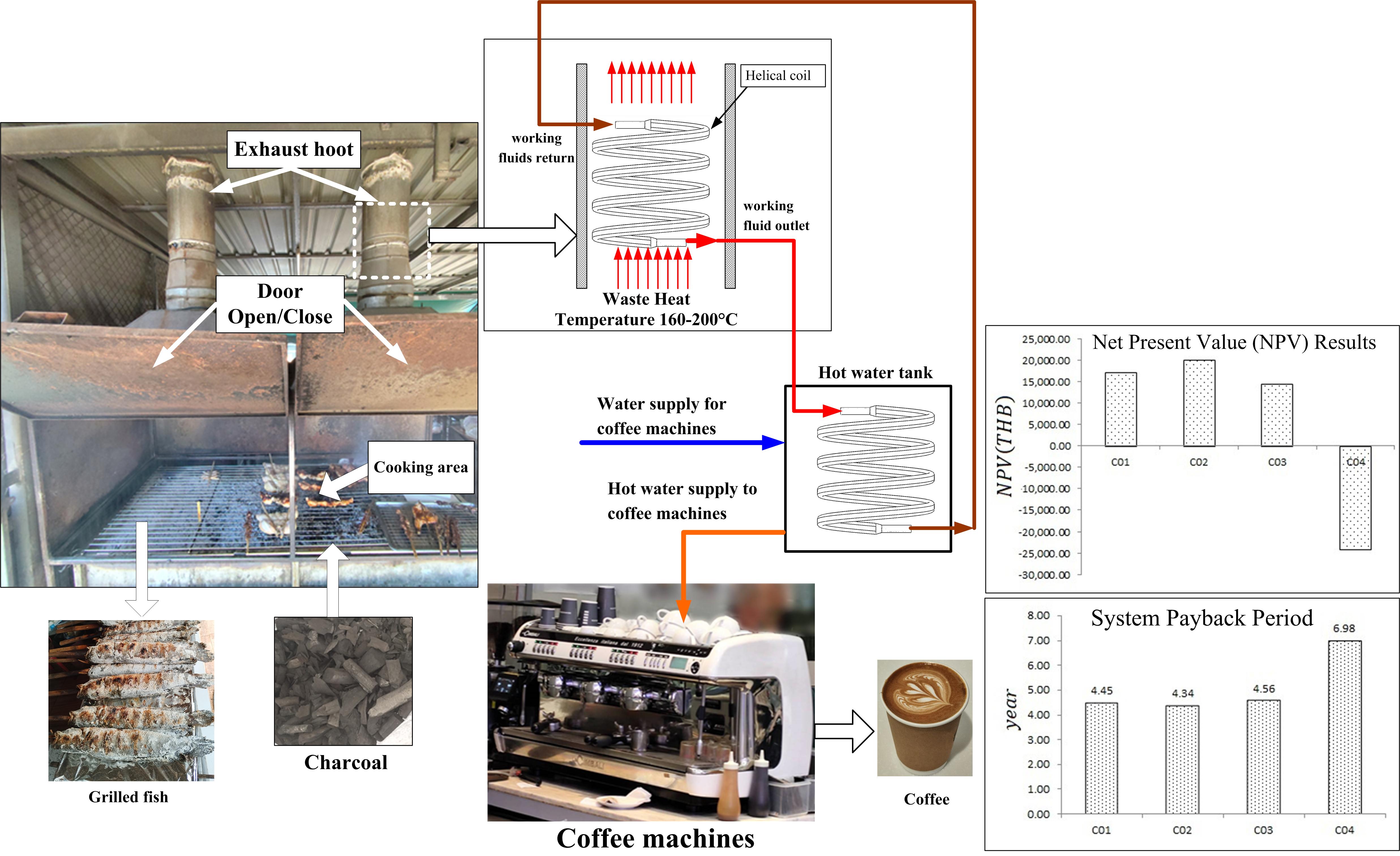
This study proposes a compact and high-performance waste-heat recovery system designed for small food-service establishments using biomass cookstoves (BCS). The system incorporates elliptical-tube helical coil heat exchangers (HHEs) to intensify secondary flows and enhance convective heat transfer compared with that of conventional circular-tube designs. Four geometric configurations (H01–H04), differing in coil diameters, pitch lengths, and tube ovalities, were evaluated through an integrated framework consisting of: (i) CFD-based thermal assessment under wall-temperature conditions of 160°C, 180°C, and 200°C; (ii) techno-economic analysis, including annual energy cost savings, net present value (NPV), and payback period; and (iii) environmental impact assessment focusing on CO₂ emission reduction. Heat-transfer oil was used as the working fluid at a constant inlet temperature of 30°C. The CFD results confirm the strong influence of coil geometry on heat-transfer enhancement. H01 consistently demonstrates the highest thermal performance, outperforming H02, H03, and H04 by 2.78%, 4.10%, and 12.83%, respectively. Deploying H01 as both the exhaust-gas ( ) and hot-water ( ) recovery units under optimal conditions (200°C and ṁ = 2.5 L/min) yields 17,144.34 kWh/year of recoverable thermal energy, equivalent to 71,422.27 THB in electricity savings. Techno-economic indicators further reveal strong feasibility, with an NPV of 263,887.97 THB and a payback period of only 1.36 years. CO₂ emission reduction reaches 3,948.17 kg/year, highlighting the system’s environmental significance. Overall, the elliptical-tube HHE configuration (H01) offers superior energy, economic, and environmental benefits for BCS-based food enterprises, aligning effectively with renewable-energy goals and contributing to more sustainable thermal practices in the food-service sector.
References
Ali, S., Faraj, J., & Khaled, M. (2024). Heat recovery from hot water drainage: CFD simulation, energy efficiency and exergoeconomic analysis of concentric tube heat exchangers. Journal of Building Engineering, 98, Article 111034. https://doi.org/10.1016/j.jobe.2024.111034
Athari, H., Kiasatmanesh, F., Haghghi, M. A., Teymourzadeh, F., Yagoublou, H., & Delpisheh, M. (2022). Investigation of an auxiliary option to meet local energy demand via an innovative small-scale geothermal-driven system: A seasonal analysis. Journal of Building Engineering, 50, Article 103902. https://doi.org/10.1016/j.jobe.2021.103902
Bank of Thailand. (2024). Annual report 2024. Retrieved from https://www.bot.or.th/content/dam/bot/documents/en/research-and-publications/reports/annual-report/AnnualReport_2024Eng.pdf
Battisti, L. (2023). Energy, power, and greenhouse gas emissions for future transition scenarios. Energy Policy, 179, Article 113626. https://doi.org/10.1016/j.enpol.2023.113626
Chater, H., Asbik, M., Mouaky, A., Koukouch, A., Belandria, V., & Sarh, B. (2023). Experimental and CFD investigation of a helical coil heat exchanger coupled with a parabolic trough solar collector for heating a batch reactor: An exergy approach. Renewable Energy, 202, 1507–1519. https://doi.org/10.1016/j.renene.2022.11.108
Deng, M., Zhang, P., Yang, H., & Ma, R. (2023). Directions to improve the thermal efficiency of household biomass cookstoves: A review. Energy and Buildings, 278, Article 112625. https://doi.org/10.1016/j.enbuild.2022.112625
Dravid, A. N., Smith, K. A., Merrill, E. W., & Brian, P. L. T. (1971). Effect of secondary fluid motion on laminar flow heat transfer in helically coiled tubes. AIChE Journal, 17(5), 1114–1122. https://doi.org/10.1002/aic.690170517
Ghazanfari, V., Shadman, M. M., Mansourzade, F., & Amini, Y. (2024). Numerical investigation of thermal-hydraulic performance enhancement in helical coil heat exchangers with twisted tube geometries. Case Studies in Thermal Engineering, 60, Article 104744. https://doi.org/10.1016/j.csite.2024.104744
Ghiwe, S. S., Kalamkar, V. R., & Sawarkar, P. D. (2024). A combined combustion and conjugate heat transfer analysis of a hybrid draft biomass cookstove. Thermal Science and Engineering Progress, 50, Article 102534. https://doi.org/10.1016/j.tsep.2024.102534
Guerron, G., Nicolalde, J. F., Martínez-Gómez, J., & Dávila, P. (2024). Implementation of a waste heat recovery prototype facility based on the Rankine cycle with a twin-screw expander. Applied Thermal Engineering, 257, Article 124233. https://doi.org/10.1016/j.applthermaleng.2024.124233
Hayyat, U., Ghiwe, S. S., Shahid, M., Khan, M. U., Sultan, M., Aleem, M., ... Riaz, F. (2025). Experiments and CFD simulation of a biomass cookstove for combustion efficiency improvement at various air conditions. Case Studies in Thermal Engineering, 47, Article 106924. https://doi.org/10.1016/j.csite.2025.106924
Iqbal, Q., Fang, S., Zhao, Y., Yao, Y., Xu, Z., Gan, H., ... Wang, K. (2023). Thermo-economic assessment of sub-ambient temperature pumped-thermal electricity storage integrated with external heat sources. Energy Conversion and Management, 285, Article 116987. https://doi.org/10.1016/j.enconman.2023.116987
Kole, A. T., & Ancha, V. R. (2025). CFD model simulation and experimental testing of a household husky biomass cook stove. Scientific African, 28, Article e02714. https://doi.org/10.1016/j.sciaf.2025.e02714
Kong, R., Deethayat, T., Asanakham, A., & Kiatsiriroat, T. (2018). Heat transfer phenomena on waste heat recovery of combustion stack gas with deionized water in helical coiled heat exchanger. Case Studies in Thermal Engineering, 12, 213–222. https://doi.org/10.1016/j.csite.2018.04.010
Lahamornchaiyakul, W. (2018). Application of K-epsilon and K-omega turbulence model for rotation analysis of vertical axis water turbine generator for community. Journal of Engineering and Innovation, 11(1), 95–104.
Lohri, C. R., Rajabu, H. M., Sweeney, D. J., & Zurbrügg, C. (2016). Char fuel production in developing countries: A review of urban biowaste carbonization. Renewable and Sustainable Energy Reviews, 59, 1514–1530. https://doi.org/10.1016/j.rser.2016.01.088
Metropolitan Electricity Authority. (2025). Automatic tariff (FT). Retrieved from https://www.mea.or.th/en/our-services/service-rates/ft/statistics
Nami, H., Mahmoudi, S. M. S., & Nemati, A. (2017). Exergy, economic and environmental impact assessment and optimization of a novel cogeneration system including a gas turbine, a supercritical CO₂ and an organic Rankine cycle (GT-HRSG/SCO₂). Applied Thermal Engineering, 110, 1315–1330. https://doi.org/10.1016/j.applthermaleng.2016.08.197
Pawar, S. S., & Sunnapwar, V. K. (2013). Experimental studies on heat transfer to Newtonian and non-Newtonian fluids in helical coils with laminar and turbulent flow. Experimental Thermal and Fluid Science, 44, 792–804. https://doi.org/10.1016/j.expthermflusci.2012.09.024
Pourhemmati, S., Mohammed, H. A., & Shafieian, A. (2024). The use of variable coil pitch of helical tube on the hydro-thermal performance improvement. Case Studies in Thermal Engineering, 53, Article 103944. https://doi.org/10.1016/j.csite.2023.103944
Ravindran, R. V., Cotter, D., Wilson, C., Huang, M. J., & Hewitt, N. J. (2024). Experimental investigation of a small-scale reversible high-temperature heat pump–organic Rankine cycle system for industrial waste heat recovery. Applied Thermal Engineering, 257, Article 124237. https://doi.org/10.1016/j.applthermaleng.2024.124237
Singh, A. P., Spriet, J., & McNabola, A. (2023). Experimental and numerical investigation of drain water heat recovery in a grease interceptor. Journal of Cleaner Production, 403, Article 136799. https://doi.org/10.1016/j.jclepro.2023.136799
Wongwut, W., & Angamnuaysiri, D. (2024). Reducing energy costs in the green caviar sorting process with hybrid solar inverter system. Industrial Technology and Engineering Pibulsongkram Rajabhat University Journal, 6(1), 56–71.
Xin, R. C., & Ebadian, M. A. (1997). The effects of Prandtl numbers on local and average convective heat transfer characteristics in helical pipes. Journal of Heat Transfer, 119(3), 467–473. https://doi.org/10.1115/1.2824120
Zhang, J., Guo, X., Wang, L., Lin, Z., & Liu, S. (2024). Dean number only cannot determine characteristics of fluid flow and heat transfer in helically coiled tubes with large curvature. Case Studies in Thermal Engineering, 55, Article 103854. https://doi.org/10.1016/j.csite.2023.103854
Zheng, J., Han, C., Hu, S., Qin, Q., Wang, J., Zhu, H., & Liang, S. (2024). Comparative experimental study on the thermal and hydraulic performances of capillary box heat exchanger and helical coil heat exchanger for surface water-source heat pump. International Communications in Heat and Mass Transfer, 159, Article 108331. https://doi.org/10.1016/j.icheatmasstransfer.2024.108331
Downloads
Published
How to Cite
Issue
Section
Categories
License
Copyright (c) 2026 Journal of Current Science and Technology

This work is licensed under a Creative Commons Attribution-NonCommercial-NoDerivatives 4.0 International License.