Real-Time Stress Profiling in University Students During Post-COVID-19 Recovery and PM2.5 Exposure Using a Web Application
DOI:
https://doi.org/10.59796/jcst.V16N2.2026.167Keywords:
progressive web application, digital stress monitoring, Subjective workload index, university students, PM2.5 air pollution, post-pandemic stress, environmental stressors, ergonomic assessment, physical performanceAbstract
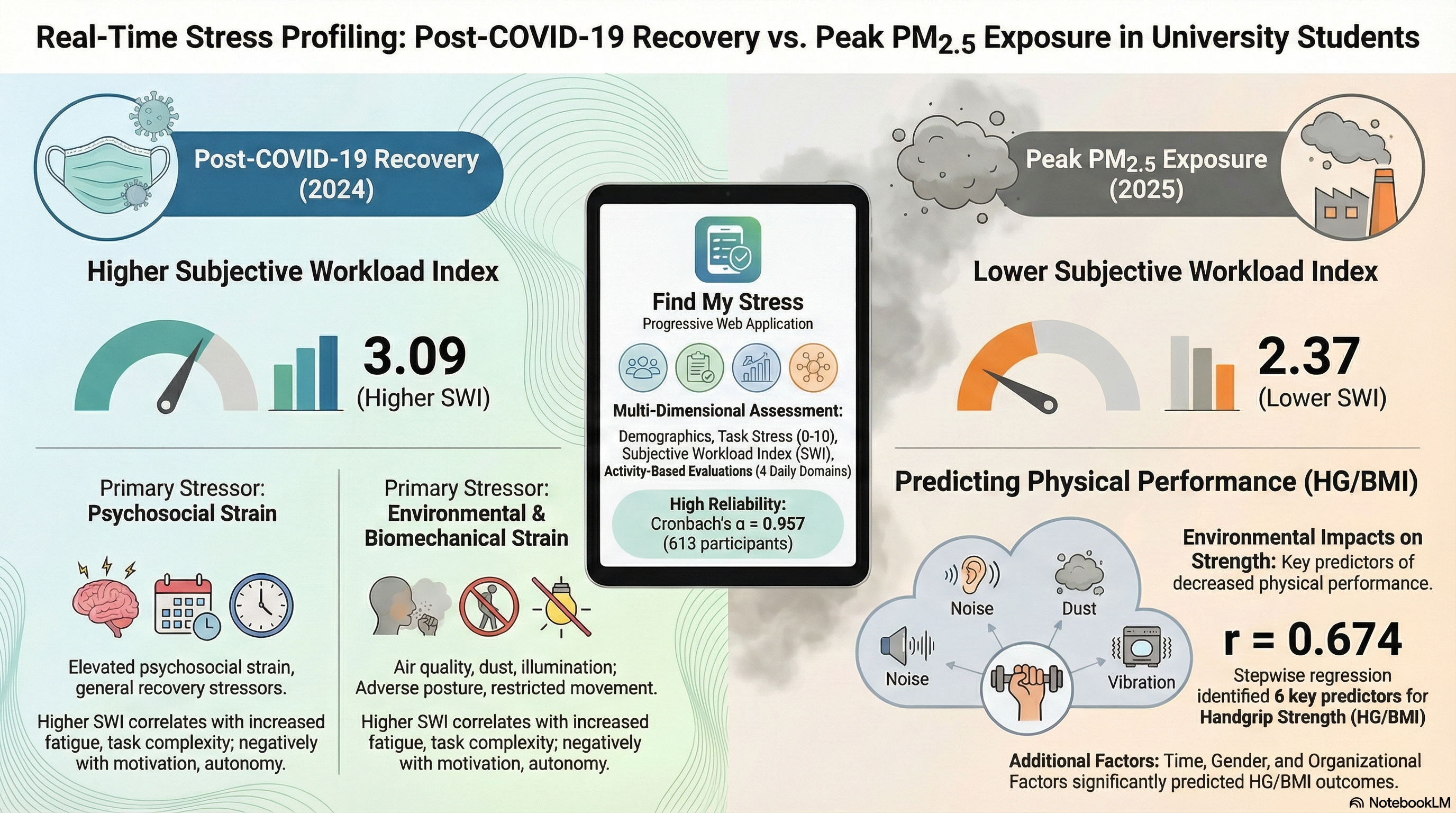
This study compared stress profiles of Thai university students during post-COVID-19 recovery (2024) and peak PM2.5 exposure (2025) using the Find My Stress Progressive Web Application (PWA). A cross-sectional design enrolled 613 students (post-COVID-19: n = 303; PM2.5: n = 310). Participants completed PWA-based assessments including demographic profiling, task-related stressor ratings (0–10 scale), Subjective Workload Index (SWI) computation, and activity-based evaluations across four daily domains. Handgrip strength normalized by BMI (HG/BMI) was measured in the PM2.5 cohort. Usability was assessed via a 14-item questionnaire (n = 372). Data were analyzed using independent-samples t-tests, Pearson correlations, and stepwise regression (p < .05). The post-COVID-19 cohort exhibited significantly higher SWI (M = 3.09, SD = 0.85) than the PM2.5 cohort (M = 2.37, SD = 0.99; p < .001, Cohen’s d = 0.78), reflecting elevated psychosocial strain. The PM2.5 cohort reported greater environmental discomfort (air quality, dust, illumination) and biomechanical burden (adverse posture, restricted movement). Stepwise regression identified six predictors of HG/BMI: time, noise, dust, vibration, organizational factors, and gender (r = 0.674, p < .001). SWI correlated positively with fatigue and task complexity and negatively with motivation and autonomy. The PWA demonstrated excellent reliability (Cronbach’s α = 0.957). The Find My Stress PWA effectively captured context-specific stress patterns: elevated psychosocial workload during post-pandemic recovery and heightened environmental strain under PM2.5 exposure. These findings support the integration of scalable digital ergonomics tools into university health systems for real-time stress monitoring.
References
Alibudbud, R. (2021). On online learning and mental health during the COVID-19 pandemic: Perspectives from the Philippines. Asian Journal of Psychiatry, 66, Article 102867. https://doi.org/10.1016/j.ajp.2021.102867
Bran, S. H., Macatangay, R., Chotamonsak, C., Chantara, S., & Surapipith, V. (2024). Understanding the seasonal dynamics of surface PM2.5 mass distribution and source contributions over Thailand. Atmospheric Environment, 331, Article 120613. https://doi.org/10.1016/j.atmosenv.2024.120613
Campbell, F., Blank, L., Cantrell, A., Baxter, S., Blackmore, C., Dixon, J., & Goyder, E. (2022). Factors that influence mental health of university and college students in the UK: A systematic review. BMC Public Health, 22(1), Article 1778. https://doi.org/10.1186/s12889-022-13943-x
Cheng, B., Pan, C., Cai, Q., Liu, L., Cheng, S., Yang, X., ... & Zhang, F. (2024). Long-term ambient air pollution and the risk of musculoskeletal diseases: A prospective cohort study. Journal of Hazardous Materials, 466, Article 133658. https://doi.org/10.1016/j.jhazmat.2024.133658
Chutipattana, N., Le, C. N., & Kaewsawat, S. (2022). Depression, anxiety, and stress during COVID-19 epidemic among public health students in Thailand. Trends in Sciences, 19(4), 2577-2577. https://doi.org/10.48048/tis.2022.2577
Department of Physical Education. (2019). Manual of Physical Fitness Tests and Standard Criteria for Thai Children, Youth, and Adults. Ministry of Tourism and Sports. Retrieved from https://prgroup.hss.moph.go.th/attachments/article/709/ebook02.pdf
Ding, Y., Wan, Q., & Liu, W. (2025). Effects of atmospherically relevant PM2.5 on skeletal muscle mitochondria: a review of damage mechanisms and potential of exercise interventions. Frontiers in Public Health, 13, Article 1615363. https://doi.org/10.3389/fpubh.2025.1615363
Dresen, V., Sigmund, L., Staggl, S., Holzner, B., Rumpold, G., Fischer-Jbali, L. R., ... & Weiss, E. (2025). Impact of COVID-19 on mental health in nursing students and non-nursing students: A cross-sectional study. Nursing Reports, 15(8), Article 286. https://doi.org/10.3390/nursrep15080286
Evans, P., Vansteenkiste, M., Parker, P., Kingsford-Smith, A., & Zhou, S. (2024). Cognitive load theory and its relationships with motivation: A self-determination theory perspective. Educational Psychology Review, 36(1), Article 7. https://link.springer.com/article/10.1007/s10648-023-09841-2
Faherty, T., Raymond, J. E., McFiggans, G., & Pope, F. D. (2025). Acute particulate matter exposure diminishes executive cognitive functioning after four hours regardless of inhalation pathway. Nature Communications, 16(1), Article 1339. https://doi.org/10.1038/s41467-025-56508-3
Ke, L., Zhang, Y., Fu, Y., Shen, X., Zhang, Y., Ma, X., & Di, Q. (2022). Short-term PM2.5 exposure and cognitive function: Association and neurophysiological mechanisms. Environment International, 170, Article 107593. https://doi.org/10.1016/j.envint.2022.107593
Malolos, G. Z. C., Baron, M. B. C., Apat, F. A. J., Sagsagat, H. A. A., Pasco, P. B. M., Aportadera, E. T. C. L., ... & Lucero-Prisno III, D. E. (2021). Mental health and well-being of children in the Philippine setting during the COVID-19 pandemic. Health Promotion Perspectives, 11(3), 267-270. https://doi.org/10.34172/hpp.2021.34
Mungkhunthod, S., Tanthanapanyakorn, P., Khantikulanon, N., & Praserttai, C. (2026). Occupational stress and associated factors among sugarcane farmers in Sa Kaeo Province, Thailand. Journal of Current Science and Technology, 16(1), Article 155. https://doi.org/10.59796/jcst.V16N1.2026.155
Murakami, K., Panuncio-Pinto, M. P., Santos, J. L. F., & de Almeida Troncon, L. E. (2025). Academic and non-academic life stressors and perceived levels of stress in Brazilian undergraduate health professions students. BMC Medical Education, 25(1), Article 1164. https://doi.org/10.1186/s12909-025-07754-y
Noiprasert, S., Buttagat, V., Sittiprapaporn, P., Sivaphongthongchai, A., & Hongsing, P. (2024). Effects of acupuncture on autonomic nervous system parameters and salivary cortisol level among mental stress university students: A pilot randomized controlled trial. Journal of Current Science and Technology, 14(2), Article 25. https://doi.org/10.59796/jcst.V14N2.2024.25
Shafiq, S., Nipa, S. N., Sultana, S., Rifat-Ur-Rahman, M., & Rahman, M. M. (2021). Exploring the triggering factors for mental stress of university students amid COVID-19 in Bangladesh: A perception-based study. Children and Youth Services Review, 120, Article 105789. https://doi.org/10.1016/j.childyouth.2020.105789
Sutthigoon, W., Chatchumni, M., Thatsiriniratkul, R., Kiennukul, N., Roungsri, W., Boonyatham, S., & Chantara, P. (2025). The face of crisis: Examining factors affecting nurses’ professional values during the COVID-19 pandemic. Nursing Reports, 15(11), Article 388. https://doi.org/10.3390/nursrep15110388
Yaban, E. H., & Gaschler, R. (2025). Autonomous motivation, self-efficacy, and developmental regulation processes in distance education across diverse age groups. American Journal of Distance Education, 1-21. https://doi.org/10.1080/08923647.2025.2484047
Yoopat, P., Deerod, P., & Keaokla, S. (2025). Comparative analysis of handgrip strength and handgrip strength-to-BMI ratio among male Thai ultimate frisbee athletes, male university athletes, and male university students: A cross-sectional study. Journal of Current Science and Technology, 15(2), Article 109. https://doi.org/10.59796/jcst.V15N2.2025.109
Yoopat, P., Thoicharoen, P., Liammanee, W., Aribarg, T., Yongsiriwit, K., & Chaisiriprasert, P. (2024). Assessment of work-related stress utilizing the Find My Stress mobile application among university students and adult workers amidst the COVID-19 pandemic. Journal of Bodywork and Movement Therapies, 39, 415-422. https://doi.org/10.1016/j.jbmt.2024.02.016
Zhang, X. (2020). A bibliometric analysis of second language acquisition between 1997 and 2018. Studies in Second Language Acquisition, 42(1), 199-222. https://doi.org/10.1017/S0272263119000573
Downloads
Published
How to Cite
License
Copyright (c) 2026 Journal of Current Science and Technology

This work is licensed under a Creative Commons Attribution-NonCommercial-NoDerivatives 4.0 International License.