A Hybrid Deep Learning and Machine Learning Approach for Predicting Aqueous Solution Concentrations
DOI:
https://doi.org/10.59796/jcst.V16N2.2026.173Keywords:
deep learning, machine learning, random forest predictor, solution concentration, VGG16Abstract
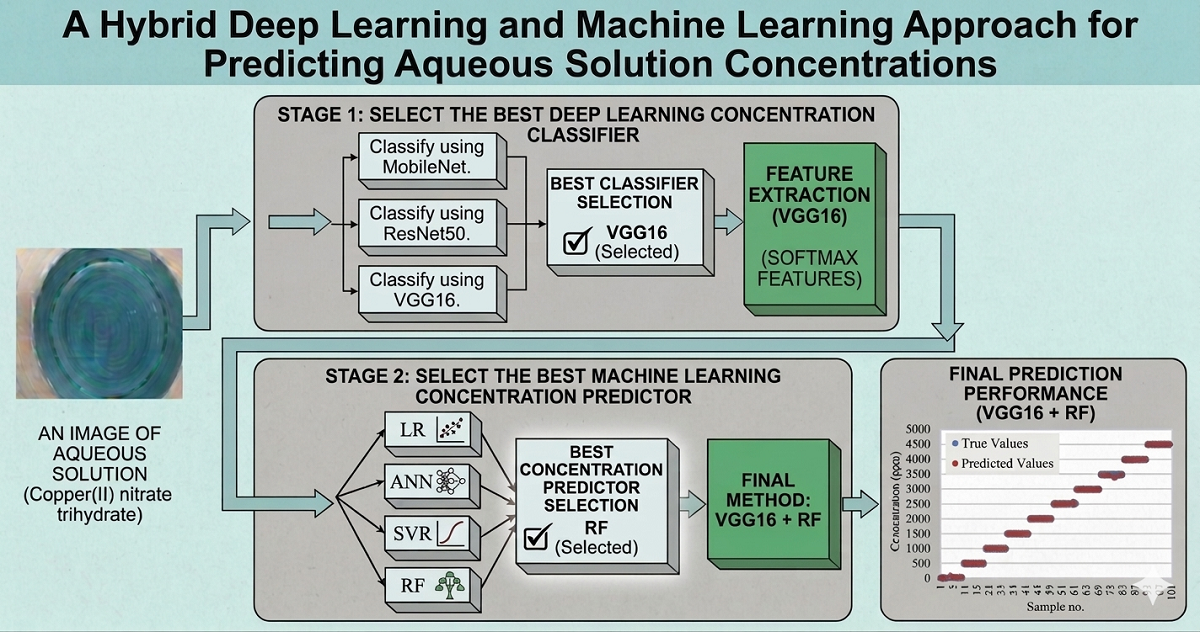
Assessing solution concentration is essential across multiple scientific disciplines; however, it is often complicated by limitations in instrument precision, sample impurities, and environmental variables. Low concentration levels frequently necessitate sophisticated methods such as spectroscopy or chromatography, which require specific apparatus and expertise. Conventional methods might be laborious and occasionally inadequate for accurate measurements. Consequently, researchers continually develop better, more efficient, and economically viable methodologies. Recent technological advancements, including deep learning and machine learning, facilitate the development of efficient, cost-effective systems for determining solution concentration levels, applicable to environmental monitoring and food safety tests. Therefore, this research developed a methodology for estimating solution concentrations through deep learning feature extraction and machine learning-based prediction. Images of the solution at varying concentrations were used to train models that apply deep learning for feature extraction. Linear regression (LR), artificial neural network (ANN), support vector regression (SVR), and random forest (RF) were then evaluated for using the extracted features to forecast the concentrations. Using features extracted from Visual Geometry Group 16-layer Convolutional Neural Network (VGG16) with LR, ANN, SVR, and RF yielded absolute prediction errors of 0.056229, 0.080000, 0.112172, and 0.026640, respectively, for concentration class prediction (classes 1–10). When the concentrations of classes 1 to 10 were evenly changed from 0 ppm to 4500 ppm, using VGG16 to extract features and RF to predict concentrations resulted in an average absolute error of 13.32 ppm, an RMSE of 0.072531 (normalized class scale) and 36.31 ppm (concentration scale), and an R² of 0.999361. The findings indicated that the proposed inexpensive method could efficiently classify the solution in different concentration classes and forecast their concentrations.
References
Chen, H., & Phoophuangpairoj, R. (2024). Determining Banana Ripeness Using MobileNet [Conference presentation]. 2024 12th International Electrical Engineering Congress (iEECON). IEEE, Pattaya, Thailand. https://doi.org/10.1109/iEECON60677.2024.10537906
Dai, J., Chen, X., Zhang, Y., Zhang, M., Dong, Y., Zheng, Q., ... & Zhao, Y. (2025). Machine learning-enhanced color recognition of test strips for rapid pesticide residue detection in fruits and vegetables. Food Control, 174, Article 111256. https://doi.org/10.1016/j.foodcont.2025.111256
Dong, X., & Phoophuangpairoj, R. (2024). Mango Maturity Classification using VGG16 [Conference presentation]. 2024 12th International Electrical Engineering Congress (iEECON). IEEE, Pattaya, Thailand. https://doi.org/10.1109/iEECON60677.2024.10537862
Feng, K., Zhai, M. Y., Wei, Y. S., Zong, M. H., Wu, H., & Han, S. Y. (2021). Fabrication of nano/micro-structured electrospun detection card for the detection of pesticide residues. Foods, 10(4), Article 889. https://doi.org/10.3390/foods10040889
Guo, K., Shen, Y., Gonzalez-Montiel, G. A., Huang, Y., Zhou, Y., Surve, M., ... & Zhang, X. (2025). Artificial intelligence in spectroscopy: Advancing chemistry from prediction to generation and beyond. arXiv preprint arXiv:2502.09897. https://doi.org/10.48550/arXiv.2502.09897
Han, Q., Yang, X., Huo, Y., Lu, J., & Liu, Y. (2023). Determination of ultra-trace amounts of copper in environmental water samples by dispersive liquid-liquid microextraction combined with graphite furnace atomic absorption spectrometry. Separations, 10(2), Article 93. https://doi.org/10.3390/separations10020093
Han, Y., Tian, Y., Li, Q., Yao, T., Yao, J., Zhang, Z., & Wu, L. (2025). Advances in detection technologies for pesticide residues and heavy metals in rice: A comprehensive review of spectroscopy, chromatography, and biosensors. Foods, 14(6), Article 1070. https://doi.org/10.3390/foods14061070
Li, Z., Liu, H., Wang, C., Chen, J., & Zhang, Q. (2022). Research on performance optimization of liquid concentration detection systems based on turbulence elimination. Processes, 11(1), Article 85. https://doi.org/10.3390/pr11010085
Miftahurrohmah, B., Cholilie, I. A., Wijaya, S. U., Atmaja, F., Bariyah, T., & Wulandari, C. (2025). Future growing seasons: Bias correction with SVR and QDM for Indonesian temperature projection under RCP 2.6 and RCP 8.5. Journal of Current Science and Technology, 15(2), Article 100. https://doi.org/10.59796/jcst.V15N2.2025.100
Paredes, C., Ahumada, D., & Ágreda, J. (2023). Gravimetric complexometric titration method to determine mass fraction of ethylenediaminetetraacetic acid disodium salt dihydrate in candidate-certified reference materials. MAPAN-Journal of Metrology Society of India, 38(1), 179-191. https://doi.org/10.1007/s12647-022-00602-0
Pechprasarn, S., Srisaranon, N., & Yimluean, P. (2025). Optimizing diabetes prediction: An evaluation of machine learning models through strategic feature selection. Journal of Current Science and Technology, 15(1), Article 75. https://doi.org/10.59796/jcst.V15N1.2025.75
Pechprasarn, S., Suechoey, N., Pholtrakoolwong, N., Tanedvorapinyo, P., & Toboonliang, Y. (2024). Optimizing lung cancer diagnosis with machine learning and feature selection methods. Journal of Current Science and Technology, 14(3), Article 55. https://doi.org/10.59796/jcst.V14N3.2024.55
Qi, M., & Phoophuangpairoj, R. (2024). Classification of snatch weightlifting phases [Conference presentation]. 2024 12th International Electrical Engineering Congress (iEECON). IEEE, Pattaya, Thailand. https://doi.org/10.1109/iEECON60677.2024.10537843
Sharma, C., Sharma, K., Trivedi, P., Sharma, S., & Yadav, N. (2025). Solvent extraction and trace analysis of as (III) in alloys, biological, and environmental samples by spectrophotometry and ICP-MS. Discover Chemistry, 2(1), Article 30. https://doi.org/10.1007/s44371-025-00108-z
Si, R., & Phoophuangpairoj, R. (2025). Detection of dangerous motorcycling using YOLO and machine learning classifiers. ECTI Transactions on Computer and Information Technology, 19(2), 294-306. https://doi.org/10.37936/ecti-cit.2025192.259018
Sun, D., Ma, X., Chang, J., Zhang, G., Su, M., Sikorski, M., ... & Bai, X. (2024). Analysis of trace heavy metal in solution using liquid cathode glow discharge spectroscopy. Sensors, 24(23), Article 7756. https://doi.org/10.3390/s24237756
Tun, N. L., Gavrilov, A., Tun, N. M., Trieu, D. M., & Aung, H. (2021). Remote sensing data classification using a hybrid pre-trained VGG16 CNN-SVM classifier [Conference presentation]. 2021 IEEE Conference of Russian Young Researchers in Electrical and Electronic Engineering (ElConRus). IEEE, St. Petersburg, Moscow, Russia. https://doi.org/10.1109/ElConRus51938.2021.9396706
Xhanari, K., & Finšgar, M. (2023). Recent advances in the modification of electrodes for trace metal analysis: A review. Analyst, 148(23), 5805-5821. https://doi.org/10.1039/D3AN01252B
Zhang, Y., Zheng, Q., Chen, X., Guan, Y., Dai, J., Zhang, M., ... & Tang, H. (2023). Comparison and analysis of several quantitative identification models of pesticide residues based on quick detection paperboard. Processes, 11(6), Article 1854. https://doi.org/10.3390/pr11061854
Zhong, J., Wang, Z., Chen, Y., Huan, W., Shi, M., Lei, L., ... & Chen, L. (2024). Determination of trace heavy metal elements in litterfall by inductively coupled plasma optical emission spectrometry after extraction using choline chloride-based deep eutectic solvents. RSC Advances, 14(31), 22497-22503. https://doi.org/10.1039/D4RA02573C
Downloads
Published
How to Cite
Issue
Section
Categories
License
Copyright (c) 2026 Journal of Current Science and Technology

This work is licensed under a Creative Commons Attribution-NonCommercial-NoDerivatives 4.0 International License.