Encapsulation of Cinnamic Acid in Cellulose Acetate Hybrid Membranes via Electrospinning and Electrospraying: A Preliminary Study Toward Wound Dressing Applications
DOI:
https://doi.org/10.59796/jcst.V16N1.2026.163Keywords:
cellulose acetate, cinnamic acid, drug delivery, electrospinning, electrospraying, membrane, wound dressingAbstract
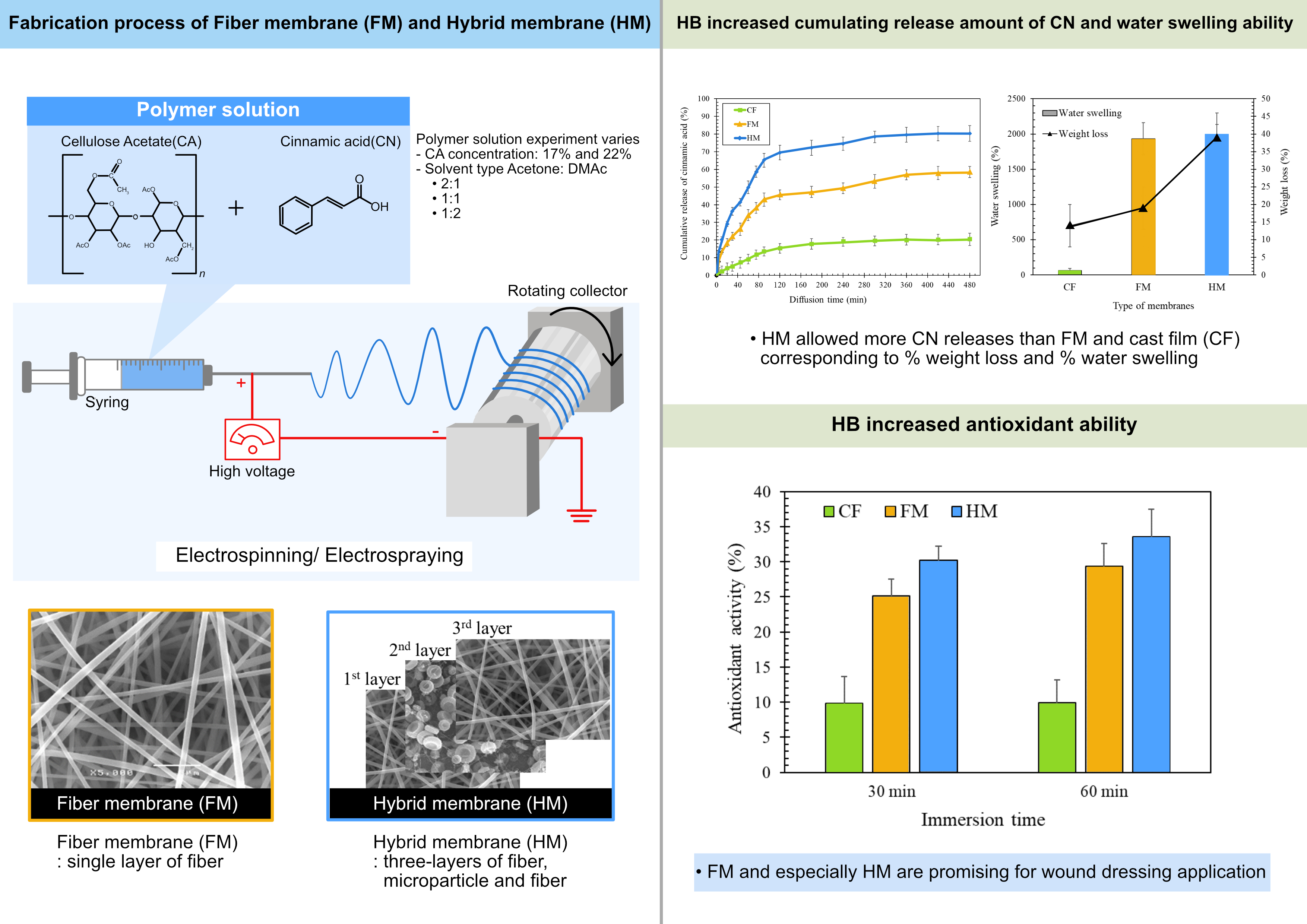
Cinnamic acid (CN) was encapsulated in electrospun cellulose acetate (CA) nanofibers and the electrosprayed CA microparticles. The hybrid membrane (HM) was fabricated as a three-layer sandwich structure composed of electrospun CN-loaded CA nanofibers as the outer layers and the electrosprayed CN-loaded CA microparticles as the inner layer. The effects of CA concentration, type of solvent, and addition of CN on the morphology and sizes of either the electrospun nanofibers or the electrosprayed microparticles were investigated. The preliminary potential for using HM as wound dressings was investigated by comparing it with the electrospun nanofibers membrane (FM) and the cast films (CF). The release characteristics of CN from each type of membrane were investigated through total immersion and diffusion using Franz cell methods. For both methods, FM and HM exhibited greater CN released than CF. However, HM allowed more convenient CN release than FM, which contained only nanofibers. The mechanical properties in terms of tensile strength, Young’s modulus, and elongation at break of these membranes were investigated. The antioxidant activities of HM, as determined by the 1,1-diphenyl-2-picrylhydrazyl (DPPH) assay, was the highest among all membrane types. All membranes exhibited antibacterial activitie against Staphylococcus aureus (S. aureus), but not against Escherichia coli (E. coli). Interestingly, HM showed the highest antibacterial activity against S. aureus. FM and especially HM may be promising for future wound dressing applications.
References
Aso, Y., Yoshioka, S., Po, A. L. W., & Terao, T. (1994). Effect of temperature on mechanisms of drug release and matrix degradation of poly (d, l-lactide) microspheres. Journal of Controlled Release, 31(1), 33-39. https://doi.org/10.1016/0168-3659(94)90248-8
Cetinkaya, T., Mendes, A. C., Jacobsen, C., Ceylan, Z., Chronakis, I. S., Bean, S. R., & García-Moreno, P. J. (2021). Development of kafirin-based nanocapsules by electrospraying for encapsulation of fish oil. LWT, 136(2), Article 110297. https://doi.org/10.1016/j.lwt.2020.110297
Demir, M. M., Yilgor, I., Yilgor, E. E. A., & Erman, B. (2002). Electrospinning of polyurethane fibers. Polymer, 43(11), 3303-3309. https://doi.org/10.1016/S0032-3861(02)00136-2
Diniz, L. R. L., Souza, M. T. D. S., Barboza, J. N., Almeida, R. N. D., & Sousa, D. P. D. (2019). Antidepressant potential of cinnamic acids: Mechanisms of action and perspectives in drug development. Molecules, 24(24), Article 4469. https://doi.org/10.3390/molecules24244469
Doshi, J., & Reneker, D. H. (1995). Electrospinning process and applications of electrospun fibers. Journal of Electrostatics, 35(2-3), 151-160. https://doi.org/10.1016/0304-3886(95)00041-8
Ekaputra, A. K., Prestwich, G. D., Cool, S. M., & Hutmacher, D. W. (2008). Combining electrospun scaffolds with electrosprayed hydrogels leads to three-dimensional cellularization of hybrid constructs. Biomacromolecules, 9(8), 2097-2103. https://doi.org/10.1021/bm800565u
Gryko, K., Kalinowska, M., Ofman, P., Choińska, R., Świderski, G., Świsłocka, R., & Lewandowski, W. (2021). Natural cinnamic acid derivatives: A comprehensive study on structural, anti/pro-oxidant, and environmental impacts. Materials, 14(20), Article 6098. https://doi.org/10.3390/ma14206098
Jayan, H., Leena, M. M., Sundari, S. S., Moses, J. A., & Anandharamakrishnan, C. (2019). Improvement of bioavailability for resveratrol through encapsulation in zein using electrospraying technique. Journal of Functional Foods, 57, 417-424. https://doi.org/10.1016/j.jff.2019.04.007
Li, S., Yang, L., He, R., & Kong, L. (2025). Food-grade synthetic and natural polymers for electrospinning/electrospraying encapsulation of bioactive compounds. Electrospinning and Electrospraying Encapsulation of Food Bioactive Compounds, 53-61. https://doi.org/10.1016/B978-0-443-22228-3.00003-3
Li, X., Niu, X., Chen, Y., Yuan, K., He, W., Yang, S., ... & Yu, D. G. (2023). Electrospraying micro-nano structures on chitosan composite coatings for enhanced antibacterial effect. Progress in Organic Coatings, 174, Article 107310. https://doi.org/10.1016/j.porgcoat.2022.107310
Liu, M., Duan, X. P., Li, Y. M., Yang, D. P., & Long, Y. Z. (2017). Electrospun nanofibers for wound healing. Materials Science and Engineering: C, 76, 1413-1423. https://doi.org/10.1016/j.msec.2017.03.034
Malheiro, J. F., Maillard, J. Y., Borges, F., & Simões, M. (2019). Biocide potentiation using cinnamic phytochemicals and derivatives. Molecules, 24(21), Article 3918. https://doi.org/10.3390/molecules24213918
Minsart, M., Van Vlierberghe, S., Dubruel, P., & Mignon, A. (2022). Commercial wound dressings for the treatment of exuding wounds: an in-depth physico-chemical comparative study. Burns & Trauma, 10, Article tkac024. https://doi.org/10.1093/burnst/tkac024
Mirjalili, M., & Zohoori, S. (2016). Review for application of electrospinning and electrospun nanofibers technology in textile industry. Journal of Nanostructure in Chemistry, 6(3), 207-213. https://doi.org/10.1007/s40097-016-0189-y
Mit‐uppatham, C., Nithitanakul, M., & Supaphol, P. (2004). Ultrafine electrospun polyamide‐6 fibers: Effect of solution conditions on morphology and average fiber diameter. Macromolecular Chemistry and Physics, 205(17), 2327-2338. https://doi.org/10.1002/macp.200400225
Mokhtari, F., Latifi, M., & Shamshirsaz, M. (2016). Electrospinning/electrospray of polyvinylidene fluoride (PVDF): Piezoelectric nanofibers. The Journal of The Textile Institute, 107(8), 1037-1055. https://doi.org/10.1080/00405000.2015.1083300
Moreira, A., Lawson, D., Onyekuru, L., Dziemidowicz, K., Angkawinitwong, U., Costa, P. F., ... & Williams, G. R. (2021). Protein encapsulation by electrospinning and electrospraying. Journal of Controlled Release, 329, 1172-1197. https://doi.org/10.1016/j.jconrel.2020.10.046
Nasari, M., Poursharifi, N., Fakhrali, A., Banitaba, S. N., Mohammadi, S., & Semnani, D. (2023). Fabrication of novel PCL/PGS fibrous scaffold containing HA and GO through simultaneous electrospinning-electrospray technique. International Journal of Polymeric Materials and Polymeric Biomaterials, 72(18), 1529-1545. https://doi.org/10.1080/00914037.2022.2112678
Neamnark, A., Rujiravanit, R., & Supaphol, P. (2006). Electrospinning of hexanoyl chitosan. Carbohydrate Polymers, 66(3), 298-305. https://doi.org/10.1016/j.carbpol.2006.03.015
Nikolaou, M., & Krasia-Christoforou, T. (2018). Electrohydrodynamic methods for the development of pulmonary drug delivery systems. European Journal of Pharmaceutical Sciences, 113, 29-40. https://doi.org/10.1016/j.ejps.2017.08.032
Opanasopit, P., Ruktanonchai, U., Suwantong, O., Panomsuk, S., Ngawhirunpat, T., Sittisombut, C., ... & Supaphol, P. (2008). Electrospun poly (vinyl alcohol) fiber mats as carriers for extracts from the fruit hull of mangosteen. Journal of Cosmetic Science, 59(3), 233-242. https://doi.org/10.1111/j.1468-2494.2009.00462_5.x
Parın, F. N., Aydemir, Ç. İ., Taner, G., & Yıldırım, K. (2022). Co-electrospun-electrosprayed PVA/folic acid nanofibers for transdermal drug delivery: Preparation, characterization, and in vitro cytocompatibility. Journal of Industrial Textiles, 51(1_suppl), 1323S-1347S. https://doi.org/10.1177/1528083721997185
Ruwizhi, N., & Aderibigbe, B. A. (2020). Cinnamic acid derivatives and their biological efficacy. International Journal of Molecular Sciences, 21(16), Article 5712. https://doi.org/10.3390/ijms21165712
Sabzi, M., Afshari, M. J., Babaahmadi, M., & Shafagh, N. (2020). pH-dependent swelling and antibiotic release from citric acid crosslinked poly (vinyl alcohol)(PVA)/nano silver hydrogels. Colloids and Surfaces B: Biointerfaces, 188, Article 110757. https://doi.org/10.1016/j.colsurfb.2019.110757
Samadian, H., Zamiri, S., Ehterami, A., Farzamfar, S., Vaez, A., Khastar, H., ... & Salehi, M. (2020). Electrospun cellulose acetate/gelatin nanofibrous wound dressing containing berberine for diabetic foot ulcer healing: In vitro and in vivo studies. Scientific Reports, 10(1), Article 8312. https://doi.org/10.1038/s41598-020-65268-7
Seo, J. Y., Cho, K. Y., Lee, J. H., Lee, M. W., & Baek, K. Y. (2020). Continuous flow composite membrane catalysts for efficient decomposition of chemical warfare agent simulants. ACS Applied Materials & Interfaces, 12(29), 32778-32787. https://doi.org/10.1021/acsami.0c08276
Shcherbakov, V. V., & Artemkina, Y. M. (2013). Dielectric properties of solvents and their limiting high-frequency conductivity. Russian Journal of Physical Chemistry A, 87(6), 1048-1051. https://doi.org/10.1134/S0036024413060241
Sheng, Z., Xu, Y., Tong, Z., Mao, Z., & Zheng, Y. (2022). Dual functional electrospun nanofiber membrane with ROS scavenging and revascularization ability for diabetic wound healing. Colloid and Interface Science Communications, 48, Article 100620. https://doi.org/10.1016/j.colcom.2022.100620
Shenoy, S. L., Bates, W. D., Frisch, H. L., & Wnek, G. E. (2005). Role of chain entanglements on fiber formation during electrospinning of polymer solutions: good solvent, non-specific polymer–polymer interaction limit. Polymer, 46(10), 3372-3384. https://doi.org/10.1016/j.polymer.2005.03.011
Taofiq, O., Heleno, S. A., Calhelha, R. C., Fernandes, I. P., Alves, M. J., Barros, L., ... & Barreiro, M. F. (2019). Phenolic acids, cinnamic acid, and ergosterol as cosmeceutical ingredients: Stabilization by microencapsulation to ensure sustained bioactivity. Microchemical Journal, 147, 469-477. https://doi.org/10.1016/j.microc.2019.03.059
Tungprapa, S., Jangchud, I., & Supaphol, P. (2007). Release characteristics of four model drugs from drug-loaded electrospun cellulose acetate fiber mats. Polymer, 48(17), 5030-5041. https://doi.org/10.1016/j.polymer.2007.06.061
Vitchuli, N., Shi, Q., Nowak, J., Kay, K., Caldwell, J. M., Breidt, F., ... & Zhang, X. (2011). Multifunctional ZnO/Nylon 6 nanofiber mats by an electrospinning–electrospraying hybrid process for use in protective applications. Science and Technology of Advanced Materials, 12(5), Article 055004. https://doi.org/10.1088/1468-6996/12/5/055004
Wutticharoenmongkol, P., Hannirojram, P., & Nuthong, P. (2019). Gallic acid‐loaded electrospun cellulose acetate nanofibers as potential wound dressing materials. Polymers for Advanced Technologies, 30(4), 1135-1147. https://doi.org/10.1002/pat.4547
Wutticharoenmongkol, P., Supaphol, P., Srikhirin, T., Kerdcharoen, T., & Osotchan, T. (2005). Electrospinning of polystyrene/poly (2‐methoxy‐5‐(2′‐ethylhexyloxy)‐1, 4‐phenylene vinylene) blends. Journal of Polymer Science Part B: Polymer Physics, 43(14), 1881-1891. https://doi.org/10.1002/polb.20478
Yanilmaz, M., Lu, Y., Dirican, M., Fu, K., & Zhang, X. (2014). Nanoparticle-on-nanofiber hybrid membrane separators for lithium-ion batteries via combining electrospraying and electrospinning techniques. Journal of Membrane Science, 456, 57-65. https://doi.org/10.1016/j.memsci.2014.01.022
Yilmaz, S. E. V. D. A. N., Sova, M., & Ergün, S. (2018). Antimicrobial activity of trans‐cinnamic acid and commonly used antibiotics against important fish pathogens and nonpathogenic isolates. Journal of Applied Microbiology, 125(6), 1714-1727. https://doi.org/10.1111/jam.14097
Yu, D. G., Gong, W., Zhou, J., Liu, Y., Zhu, Y., & Lu, X. (2024). Engineered shapes using electrohydrodynamic atomization for an improved drug delivery. Wiley Interdisciplinary Reviews: Nanomedicine and Nanobiotechnology, 16(3), Article e1964. https://doi.org/10.1002/wnan.1964
Downloads
Published
How to Cite
Issue
Section
Categories
License
Copyright (c) 2025 Journal of Current Science and Technology

This work is licensed under a Creative Commons Attribution-NonCommercial-NoDerivatives 4.0 International License.