Effects of Land Use Change and Climate Projections on Erosion and Sediment Transport in the Kricik River Basin, Indonesia: A Modeling Study
DOI:
https://doi.org/10.59796/jcst.V16N2.2026.177Keywords:
erosion, sedimentation, Kricik River, land use, MUSLE, climate changeAbstract
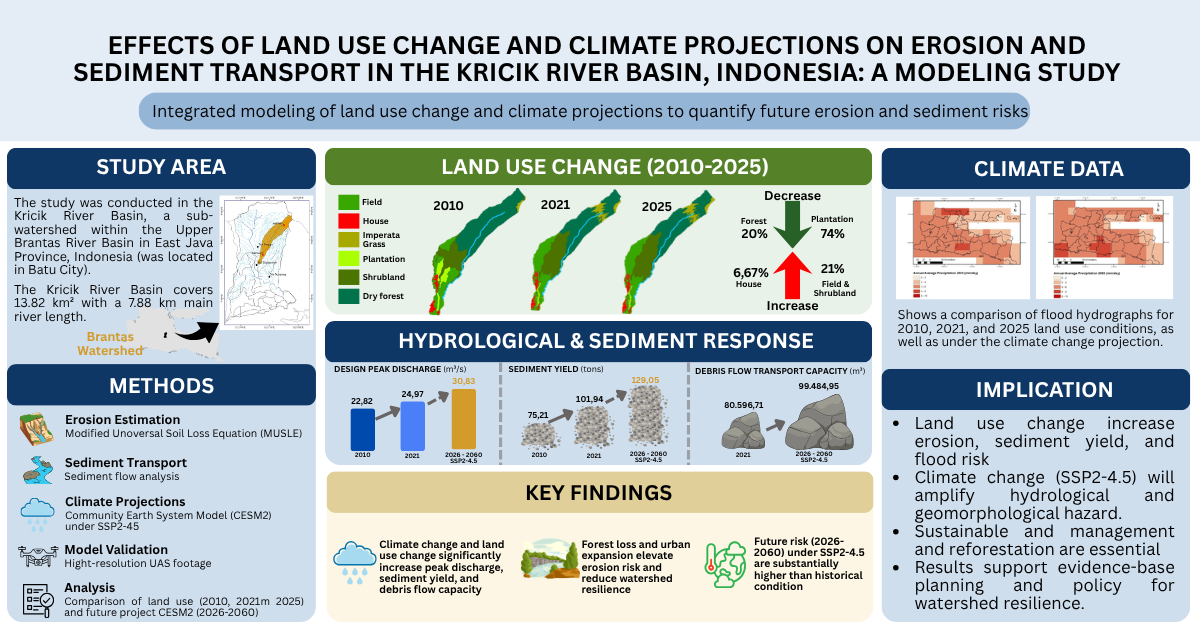
This research assessed the effects of land use change and climate change on the rates of erosion and sediment transport volumes. To quantify erosion and sediment mobilization, the Modified Universal Soil Loss Equation was applied in conjunction with sediment transport analysis. Precipitation projections from the Community Earth System Model Version 2 under the Shared Socioeconomic Pathway SSP2-4.5 scenario were employed to evaluate future climate impacts. Model validation was improved using high-resolution Unmanned Aerial Vehicle (UAV) footage. The study area was the Kricik River watershed, located in East Java, Indonesia. This watershed strongly affects the hydrological and sedimentary processes of the broader Brantas River basin. A comparative analysis of land use across 2010, 2021, and 2025 revealed a decline in forest and plantation cover, accompanied by an increase in dryland and urban development. Under the 2021 condition, the design peak discharge increased from 22.82 m³/s to 24.97 m³/s, while sediment yield rose to 101.94 tons, up from 75.21 tons in 2010. Climate change forecasts for 2026–2060 under SSP2-4.5 showed a substantial increase in hydrological and geomorphological hazards, with the expected peak discharge estimated at 30.83 m³/s. The sediment yield in this scenario escalated to 129.05 tons, whereas the capacity of debris flow transport increased from 80,596.71 m³ to 99,484.95 m³. The study provides actionable insights for watershed managers and policymakers, highlighting the importance of climate adaptation and sustainable land use planning to alleviate future hazards of erosion, sedimentation, and flooding. The findings emphasize that policymakers should prioritize the development and enforcement of land use zoning regulations and watershed conservation policies that limit impervious surface expansion, encourage reforestation or agroforestry, and protect upstream buffer zones to control runoff coefficients.
References
Acharya, B. S., Bhandari, M., Bandini, F., Pizarro, A., Perks, M., Joshi, D. R., ... & Sharma, S. (2021). Unmanned aerial vehicles in hydrology and water management: Applications, challenges, and perspectives. Water Resources Research, 57(11), Article e2021WR029925. https://doi.org/10.1029/2021WR029925
Adeyeri, O. E., Folorunsho, A. H., Adeliyi, T. E., Ayegbusi, K. I., Akinsanola, A. A., Ndehedehe, C. E., ... & Babalola, T. E. (2024). Climate change is intensifying rainfall erosivity and soil erosion in West Africa. Science of the Total Environment, 955, Article 177174. https://doi.org/10.1016/j.scitotenv.2024.177174
An, L. S., Liao, K. H., Zhou, B. H., Pan, W., & Chen, Q. (2016). Global sensitivity analysis of the parameters of the modified universal soil loss equation. Applied Ecology and Environmental Research, 14(4), 505-514. https://doi.org/10.15666/aeer/1404_505514
Borrelli, P., Alewell, C., Alvarez, P., Anache, J. A. A., Baartman, J., Ballabio, C., ... & Panagos, P. (2021). Soil erosion modelling: A global review and statistical analysis. Science of the Total Environment, 780, Article 146494. https://doi.org/10.1016/j.scitotenv.2021.146494
Danabasoglu, G., Lamarque, J. F., Bacmeister, J., Bailey, D. A., DuVivier, A. K., Edwards, J., ... & Strand, W. G. (2020). The community earth system model version 2 (CESM2). Journal of Advances in Modeling Earth Systems, 12(2), Article e2019MS001916. https://doi.org/10.1029/2019MS001916
Dash, S. S., & Maity, R. (2023). Effect of climate change on soil erosion indicates a dominance of rainfall over LULC changes. Journal of Hydrology: Regional Studies, 47, Article 101373. https://doi.org/10.1016/j.ejrh.2023.101373
Faksomboon, B. (2023). Predicting spatial land use and land cover change using an integrated mathematical model in the Khlong Nam Lai Watershed, Kamphaeng Phet Province, Thailand. EnvironmentAsia, 16(1), 16-27. https://doi.org/10.14456/EA.2023.2
Hernina, R., Martono, D. N., Koestoer, R. H., & Soesilo, T. E. B. (2024). Land use/land cover simulation scenarios in Bogor and Karawang regencies’ border area, Indonesia, using GIS-based multi-stakeholder tourism analysis. EnvironmentAsia, 17(1), 69-82. https://doi.org/10.14456/ea.2024.6
Hidayat, A., Limantara, L. M., Soetopo, W., & Sisinggih, D. (2022). Alpha parameter modeling of Nakayasu synthetic unit hydrograph based on the watershed shape factor. Journal of Hunan University Natural Sciences, 49(1), 31–37. https://doi.org/10.55463/issn.1674-2974.49.1.5
Intergovernmental Panel on Climate Change. (2023). Climate change 2023: Synthesis report. Contribution of Working Groups I, II and III to the Sixth Assessment Report of the Intergovernmental Panel on Climate Change (Core Writing Team, H. Lee, & J. Romero, Eds.). IPCC. https://doi.org/10.59327/IPCC/AR6-9789291691647
Kang, M. S., Goo, J. H., Song, I., Chun, J. A., Her, Y. G., Hwang, S. W., & Park, S. W. (2013). Estimating design floods based on the critical storm duration for small watersheds. Journal of Hydro-Environment Research, 7(3), 209-218. https://doi.org/10.1016/j.jher.2013.01.003
Kulkarni, S. (2021). Climate change, soil erosion risks, and nutritional security. Climate Change and Resilient Food Systems: Issues, Challenges, and Way Forward, 219-244. https://doi.org/10.1007/978-981-33-4538-6_8
Lagogiannis, S., & Dimitriou, E. (2021). Discharge estimation with the use of unmanned aerial vehicles (UAVs) and hydraulic methods in shallow rivers. Water, 13(20), Article 2808. https://doi.org/10.3390/w13202808
Leh, M., Bajwa, S., & Chaubey, I. (2013). Impact of land use change on erosion risk: An integrated remote sensing, geographic information system and modeling methodology. Land Degradation & Development, 24(5), 409-421. https://doi.org/10.1002/ldr.1137
Li, N., Zhang, Y., Wang, T., Li, J., Yang, J., & Luo, M. (2022). Have anthropogenic factors mitigated or intensified soil erosion over the past three decades in South China?. Journal of Environmental Management, 302, Article 114093. https://doi.org/10.1016/j.jenvman.2021.114093
Mizuyama, T. (2008). Structural countermeasures for debris flow disasters. International Journal of Erosion Control Engineering, 1(2), 38-43. https://doi.org/10.13101/ijece.1.38
Mohammadi, M., Khaledi Darvishan, A., Spalevic, V., Dudic, B., & Billi, P. (2021). Analysis of the impact of land use changes on soil erosion intensity and sediment yield using the intero model in the talar watershed of Iran. Water, 13(6), Article 881. https://doi.org/10.3390/w13060881
Moriasi, D. N., Arnold, J. G., Van Liew, M. W., Bingner, R. L., Harmel, R. D., & Veith, T. L. (2007). Model evaluation guidelines for systematic quantification of accuracy in watershed simulations. Transactions of the ASABE, 50(3), 885-900. https://doi.org/10.13031/2013.23153
Nakayasu, Y. (1956). On the unit graph of Japanese river floods. Ministry of Construction, 7th Technical Research Meeting Report. Retrieved from https://www.jstage.jst.go.jp/browse/prohe1956/1/0/_contents/-char/ja
Nassor, S. H., Matlan, S. J., Taha, N. A., & Mukhlisin, M. (2025). Influence of hydraulic properties on the slope stability of unsaturated soil from the garinono formation in Sabah. Journal of Current Science and Technology, 15(1), Article 88. https://doi.org/10.59796/jcst.V15N1.2025.88
Odongo, V. O., Onyando, J. O., Mutua, B. M., & Becht, R. (2013). Sensitivity analysis and calibration of the Modified Universal Soil Loss Equation (MUSLE) for the upper Malewa catchment, Kenya. International Journal of Sediment Research, 28(3), 368-383. https://doi.org/10.1016/S1001-6279(13)60047-5
Prokešová, R., Horáčková, Š., & Snopková, Z. (2022). Surface runoff response to long-term land use changes: Spatial rearrangement of runoff-generating areas reveals a shift in flash flood drivers. Science of the Total Environment, 815, Article 151591. https://doi.org/10.1016/j.scitotenv.2021.151591
Pumpuang, A., & Aobpaet, A. (2024). Evolution pattern of land subsidence using InSAR Time-series analysis in Bangkapi, Bangkok, Thailand. Journal of Current Science and Technology, 14(3), Article 49. https://doi.org/10.59796/jcst.V14N3.2024.49
Putri, F. S., Hapsari, R. I., & Harsanti, W. (2022). Planning of a sabo dam on the Kricik River for flood control in Bumiaji District, Batu City (in Indonesian). Jurnal Online Skripsi Manajemen Rekayasa Konstruksi (JOS-MRK), 3(4), 13–19. https://jurnal.polinema.ac.id/index.php/jos-mrk/article/view/1081
Ray, R., Samui, P., & Roy, L. B. (2023). Reliability analysis of a shallow foundation on clayey soil based on settlement criteria. Journal of Current Science and Technology, 13(1), 91-106. https://doi.org/10.14456/jcst.2023.9
Shu, Y., & Lam, N. S. (2011). Spatial disaggregation of carbon dioxide emissions from road traffic based on multiple linear regression model. Atmospheric Environment, 45(3), 634-640. https://doi.org/10.1016/j.atmosenv.2010.10.037
Takahashi, T. (1977). A mechanism of occurrence of mud-debris flow and their characteristics in motion. Annuals, Disaster Prevention Research Institute Kyoto University, 20, 405-432.
Takahashi, T. (1978). The occurrence and flow mechanism of debris flow. Soil Mechanics and Foundation Engineering, 26(6), 45-50.
Takahashi, T. (2001). Process of occurrence, flow and deposition of viscous debris flow. River, coastal and estuarine morphodynamics. Berlin, Heidelberg: Springer Berlin Heidelberg.
Westra, S., Alexander, L. V., & Zwiers, F. W. (2013). Global increasing trends in annual maximum daily precipitation. Journal of Climate, 26(11), 3904-3918. https://doi.org/10.1175/JCLI-D-12-00502.1
Williams, J. R. (1975). Sediment-yield prediction with universal equation using runoff energy factor. Retrieved from https://www.semanticscholar.org/paper/Sediment-yield-prediction-with-Universal-Equation-Williams/a9bc4612310f980c973575cbf86c63b77a01ace1
Wischmeier, W. H., & Smith, D. D. (1978). Predicting rainfall erosion losses: A guide to conservation planning (Agriculture Handbook No. 537). U.S. Department of Agriculture. Retrieved from https://books.google.co.th/books/about/Predicting_Rainfall_Erosion_Losses.html?id=rRAUAAAAYAAJ&redir_esc=y
Wiwoho, B. S., McIntyre, N., & Phinn, S. (2024). Assessing future land-uses under planning scenarios: A case study of The Brantas River Basin, Indonesia. Environmental Challenges, 15, Article 100873. https://doi.org/10.1016/j.envc.2024.100873
Xiao, T., Ran, F., Li, Z., Wang, S., Nie, X., Liu, Y., ... & Feng, S. (2023). Sediment organic carbon dynamics response to land use change in diverse watershed anthropogenic activities. Environment International, 172, Article 107788. https://doi.org/10.1016/j.envint.2023.107788
Yang, D., Kanae, S., Oki, T., Koike, T., & Musiake, K. (2003). Global potential soil erosion with reference to land use and climate changes. Hydrological Processes, 17(14), 2913-2928. https://doi.org/10.1002/hyp.1441
Zhou, G., Wei, X., Luo, Y., Zhang, M., Li, Y., Qiao, Y., ... & Wang, C. (2010). Forest recovery and river discharge at the regional scale of Guangdong Province, China. Water Resources Research, 46(9), Article W09503. https://doi.org/10.1029/2009WR008829
Downloads
Published
How to Cite
Issue
Section
Categories
License
Copyright (c) 2026 Journal of Current Science and Technology

This work is licensed under a Creative Commons Attribution-NonCommercial-NoDerivatives 4.0 International License.