Effects of Short-term Drought Stress on Chlorophyll Fluorescence and Proline Content of Ficus annulata
DOI:
https://doi.org/10.59796/jcst.V16N1.2026.150Keywords:
banyan tree, carbon dioxide, chlorophyll fluorescence, drought re-watering, photosynthesis, proline, short-term drought, water deficitAbstract
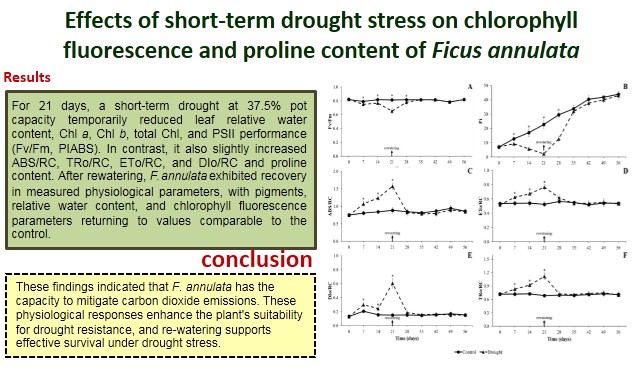
Drought is still one of the key factors that directly affects the rate of photosynthesis and the reduction of plant growth and yield. This study was carried out to investigate the effect of drought and re-watering trials on the contents of chlorophyll, carotenoids, proline, CO2 fluxes, and the photosynthetic efficiency of Ficus annulata. Treatments included control (no drought) and drought-stressed plants exposed to 21 days of drought followed by re-watering, with four replications conducted over 56 days. The results showed that drought stress greatly reduced the amounts of chlorophyll and carotenoids, with the highest reduction in relative water content (RWC) observed at 76–79% (p ≤ 0.05). Conversely, proline content significantly increased during drought stress, exhibiting the highest value of 108.16 µg/g FW before re-watering (p ≤ 0.05). A 21-day short-term drought had a statistically significant effect on changes in chlorophyll fluorescence parameters and CO2 flux (p ≤ 0.05). However, the overall plant response after re-watering showed no significant difference compared with the control (p > 0.05), suggesting recovery of physiological efficiency. Our findings indicated that F. annulata has the capacity to mitigate carbon dioxide emissions. These physiological responses enhance the plant's suitability for drought resistance, and re-watering supports effective survival under drought stress.
References
Banks, J. M. (2018). Chlorophyll fluorescence as a tool to identify drought stress in Acer genotypes. Environmental and Experimental Botany, 155, 118–127. https://doi.org/10.1016/j.envexpbot.2018.06.022
Bates, L. S., Waldren, R. P. A., & Teare, I. D. (1973). Rapid determination of free proline for water-stress studies. Plant and Soil, 39(1), 205–207. https://doi.org/10.1007/BF00018060
Binukumar, A. K., & Lovely, B. (2024). Proline accumulation and drought tolerance in green gram (Vigna radiata L.). International Journal of Plant & Soil Science, 36(10), 473–483. https://doi.org/10.9734/ijpss/2024/v36i105098
Challabathula, D., Puthur, J. T., & Bartels, D. (2016). Surviving metabolic arrest: Photosynthesis during desiccation and rehydration in resurrection plants. Annals of the New York Academy of Sciences, 1365(1), 89–99. https://doi.org/10.1111/nyas.12884
Del Rosario Jacobo-Salcedo, M., David Valdez-Cepeda, R., Sánchez-Cohen, I., González-Espíndola, L. Á., Arreola-Ávila, J. G., & Trejo-Calzada, R. (2024). Physiological mechanisms in Ficus carica L. genotypes in response to moisture stress. Agronomy Research, 22(S2), 685–702. https://doi.org/10.15159/AR.24.047
Demmig-Adams, B., & Adams, W. W. (2018). An integrative approach to photoinhibition and photoprotection of photosynthesis. Environmental and Experimental Botany, 154, 1–3. https://doi.org/10.1016/j.envexpbot.2018.05.006
Farooq, M. A., Niazi, A. K., Akhtar, J., Farooq, M., Souri, Z., Karimi, N., & Rengel, Z. (2019). Acquiring control: The evolution of ROS-induced oxidative stress and redox signaling pathways in plant stress responses. Plant Physiology and Biochemistry, 141, 353–369. https://doi.org/10.1016/j.plaphy.2019.04.039
Farooq, M., Wahid, A., Kobayashi, N. S. M. A., Fujita, D. B. S. M. A., & Basra, S. M. (2009). Plant drought stress: Effects, mechanisms and management. Sustainable Agriculture (pp.153-188). Dordrecht: Springer Netherlands. https://doi.org/10.1007/978-90-481-2666-8_12
Hanpattanakit, P., Wattanahemmakorn, J., Sudjarit, T., Jaiarree, S., & Taweekij, S. (2017). Soil respiration in rubber tree plantation applied with biochar. Research Journal of Chemistry and Environment, 21(10), 27–34. https://www.researchgate.net/publication/322940107
Hasanuzzaman, M., Nahar, K., Anee, T. I., Khan, M. I. R., & Fujita, M. (2018). Silicon-mediated regulation of antioxidant defense and glyoxalase systems confers drought stress tolerance in Brassica napus L. South African Journal of Botany, 115, 50–57. https://doi.org/10.1016/j.sajb.2017.12.006
Holopainen, J. K., Virjamo, V., Ghimire, R. P., Blande, J. D., Julkunen-Tiitto, R., & Kivimäenpää, M. (2018). Climate change effects on secondary compounds of forest trees in the Northern Hemisphere. Frontiers in Plant Science, 9, Article 1445. https://doi.org/10.3389/fpls.2018.01445
Kaewthongrach, R., Vitasse, Y., Lamjiak, T., & Chidthaisong, A. (2019). Impact of severe drought during the strong 2015/2016 El Niño on the phenology and survival of secondary dry dipterocarp species in Western Thailand. Forests, 10(11), Article 967. https://doi.org/10.3390/f10110967
Kliangsaard, T., Puangchit, L., & Suanpaga, W. (2020). Carbon dioxide sequestration and carbon storage in trees at the Santiphap Park Bangkok. Thai Journal of Forestry, 39(1), 86–96.
Lupitu, A., Moisa, C., Bortes, F., Peteleu, D., Dochia, M., Chambre, D., ... & Copolovici, L. (2023). The impact of increased CO₂ and drought stress on the secondary metabolites of cauliflower (Brassica oleracea var. botrytis) and cabbage (Brassica oleracea var. capitata). Plants, 12(17), Article 3098. https://doi.org/10.3390/plants12173098
Mahmood, T., Khalid, S., Abdullah, M., Ahmed, Z., Shah, M. K. N., Ghafoor, A., & Du, X. (2019). Insights into drought stress signaling in plants and the molecular genetic basis of cotton drought tolerance. Cells, 9(1), Article 105. https://doi.org/10.3390/cells9010105
Malambane, G., Batlang, U., Ramolekwa, K., Tsujimoto, H., & Akashi, K. (2021). Growth chamber and field evaluation of physiological factors of two watermelon genotypes. Plant Stress, 2, Article 100017. https://doi.org/10.1016/j.stress.2021.100017
Martinazzo, E. G., Ramm, A., & Bacarin, M. A. (2012). The chlorophyll a fluorescence as an indicator of temperature stress in the leaves of Prunus persica. Brazilian Journal of Plant Physiology, 24(4), 237–246. https://doi.org/10.1590/S1677-04202013005000001
Mathur, S., Jajoo, A., Mehta, P., & Bharti, S. (2011). Analysis of elevated temperature-induced inhibition of photosystem II using chlorophyll a fluorescence induction kinetics in wheat leaves (Triticum aestivum). Plant Biology, 13(1), 1–6. https://doi.org/10.1111/j.1438-8677.2009.00319.x
Meng, L. L., Song, J. F., Wen, J., Zhang, J., & Wei, J. H. (2016). Effects of drought stress on fluorescence characteristics of photosystem II in leaves of Plectranthus Scutellarioides. Photosynthetica, 54(3), 414–421. https://doi.org/10.1007/s11099-016-0191-0
Muhammad, I., Shalmani, A., Ali, M., Yang, Q. H., Ahmad, H., & Li, F. B. (2021). Mechanisms regulating the dynamics of photosynthesis under abiotic stresses. Frontiers in Plant Science, 11, Article 615942. https://doi.org/10.3389/fpls.2020.615942
Oguz, M. C., Aycan, M., Oguz, E., Poyraz, I., & Yildiz, M. (2022). Drought stress tolerance in plants: Interplay of molecular, biochemical and physiological responses in important development stages. Physiologia, 2(4), 180–197. https://doi.org/10.3390/physiologia2040015
Oukarroum, A., Schansker, G., & Strasser, R. J. (2009). Drought stress effects on photosystem I content and photosystem II thermotolerance analyzed using Chl a fluorescence kinetics in barley varieties differing in their drought tolerance. Physiologia Plantarum, 137(2), 188–199. https://doi.org/10.1111/j.1399-3054.2009.01273.x
Ozturk, M., Turkyilmaz Unal, B., García-Caparrós, P., Khursheed, A., Gul, A., & Hasanuzzaman, M. (2021). Osmoregulation and its actions during drought stress in plants. Physiologia Plantarum, 172(2), 1321–1335. https://doi.org/10.1111/ppl.13297
Rai, A. C., & Rai, K. K. (2020). Drought stress and its mitigation and management strategies in crop plants. Sustainable Agriculture in the Era of Climate Change. Cham: Springer International Publishing.
Rasingam, L., & Upadhyay, G. K. (2013). Knema andamanica (Warb.) W. J. de Wilde subsp. peninsularis W. J. de Wilde (Myristicaceae) and Ficus annulata Blume (Moraceae) — New additions to the flora of India. Taiwania, 58(4), 295–299. https://doi.org/10.6165/tai.2013.58.295
Reddy, A. R., Chaitanya, K. V., & Vivekanandan, M. (2004). Drought-induced responses of photosynthesis and antioxidant metabolism in higher plants. Journal of Plant Physiology, 161(11), 1189-1202. https://doi.org/10.1016/j.jplph.2004.01.013
Schonfeld, M. A., Johnson, R. C., Carver, B. F., & Mornhinweg, D. W. (1988). Water relations in winter wheat as drought resistance indicators. Crop Science, 28(3), 526–531. https://doi.org/10.2135/cropsci1988.0011183X002800030021x
Sevik, H., Cetin, M., Guney, K., & Belkayali, N. (2017). The influence of house plants on indoor CO₂. Polish Journal of Environmental Studies, 26(4), 1643–1651. https://doi.org/10.15244/pjoes/68875
Shanker, A. K., Amirineni, S., Bhanu, D., Yadav, S. K., Jyothilakshmi, N., Vanaja, M., ... & Singh, V. K. (2022). High-resolution dissection of photosystem II electron transport reveals differential response to water deficit and heat stress in pearl millet [Pennisetum glaucum (L.) R. Br.]. Frontiers in Plant Science, 13, Article 892676. https://doi.org/10.3389/fpls.2022.892676
Shin, Y. K., Bhandari, S. R., Jo, J. S., Song, J. W., & Lee, J. G. (2021). Effect of drought stress on chlorophyll fluorescence parameters, phytochemical contents and antioxidant activities in lettuce seedlings. Horticulturae, 7(8), Article 238. https://doi.org/10.3390/horticulturae7080238
Sousaraei, N., Mashayekhi, K., Mousavizadeh, S. J., Akbarpour, V., Medina, J., & Aliniaeifard, S. (2021). Screening of tomato landraces for drought tolerance based on growth and chlorophyll fluorescence analyses. Horticulture, Environment, and Biotechnology, 62(4), 521–535. https://doi.org/10.1007/s13580-020-00328-5
Sumanta, N., Haque, C. I., Nishika, J., & Suprakash, R. (2014). Spectrophotometric analysis of chlorophylls and carotenoids from commonly grown fern species by using various extracting solvents. Research Journal of Chemical Sciences, 4(9), 63–69.
Ulfat, A., Shokat, S., Li, X., Fang, L., Großkinsky, D. K., Majid, S. A., ... & Liu, F. (2021). Elevated carbon dioxide alleviates the negative impact of drought on wheat by modulating plant metabolism and physiology. Agricultural Water Management, 250, Article 106804. https://doi.org/10.1016/j.agwat.2021.106804
Xu, J., Guo, L., & Liu, L. (2022). Exogenous silicon alleviates drought stress in maize by improving growth, photosynthetic and antioxidant metabolism. Environmental and Experimental Botany, 201, Article 104974. https://doi.org/10.1016/j.envexpbot.2022.104974
Yang, X., Lu, M., Wang, Y., Wang, Y., Liu, Z., & Chen, S. (2021). Response mechanism of plants to drought stress. Horticulturae, 7(3), Article 50. https://doi.org/10.3390/horticulturae7030050
Yao, J., Sun, D., Cen, H., Xu, H., Weng, H., Yuan, F., & He, Y. (2018). Phenotyping of Arabidopsis drought stress response using kinetic chlorophyll fluorescence and multicolor fluorescence imaging. Frontiers in Plant Science, 9, Article 603. https://doi.org/10.3389/fpls.2018.00603
Downloads
Published
How to Cite
Issue
Section
License
Copyright (c) 2025 Journal of Current Science and Technology

This work is licensed under a Creative Commons Attribution-NonCommercial-NoDerivatives 4.0 International License.