Accurate Air Quality Index Prediction Using MPRKDNN with Optimized Feature Selection
DOI:
https://doi.org/10.59796/jcst.V16N1.2026.148Keywords:
air quality index prediction, deep neural network, feature selection, MPCI, RBK-QDA, Tietjen–Moore TestAbstract
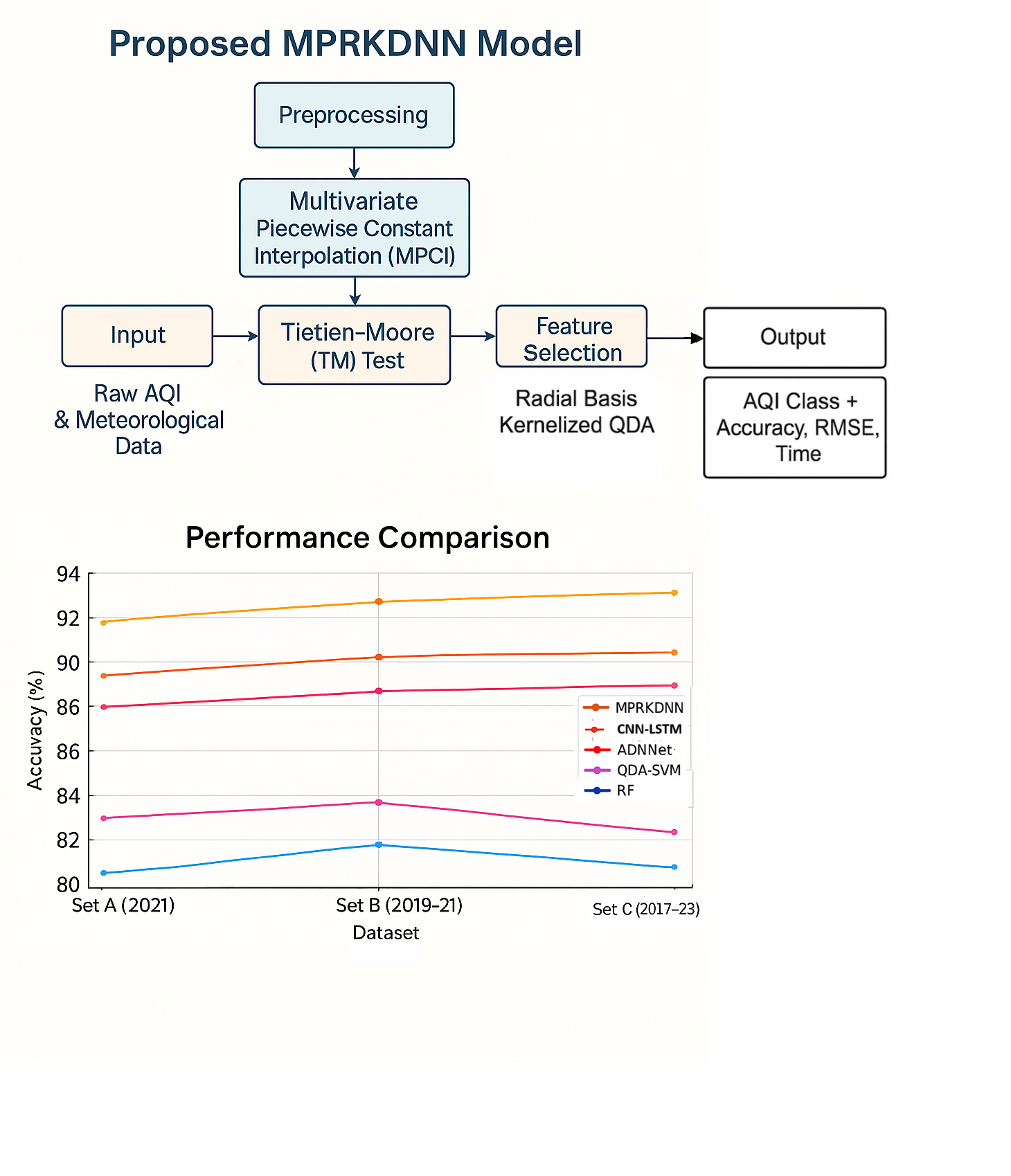
Air quality forecasting is essential for managing environmental and health impacts in rapidly urbanizing regions. The AQI short for Air Quality Index is a standardized measure used to communicate the severity of air pollution based on several pollutant indicators. However, accurately classifying AQI levels remains challenging due to the highly irregular nature of real-world datasets, which often include missing values, noise and redundant variables. Prediction accuracy largely depends on algorithmic complexity and the quality of input data preparation and refinement. To overcome these practical data-related limitations and improve AQI classification, a structured and adaptive model design becomes necessary. This study presents a modular and organized learning framework, Multivariate Piecewise Radial Kernelized Deep Neural Network (MPRKDNN), designed to enhance AQI classification through intelligent preprocessing and targeted feature selection. This process involves estimating missing values using Multivariate Piecewise Constant Interpolation (MPCI) and detecting outliers using the Tietjen-Moore statistical test. Radial Basis Kernelized Quadratic Discriminant Analysis (RBK-QDA) is used to retain the relevant variables and reduce dimensionality. The final output is fed into a deep feed-forward neural network trained using Stochastic Gradient Descent (SGD) for final classification.
The model is evaluated using multicity AQI datasets from India during 2017 to 2023. Comparative studies conducted against baseline deep learning and hybrid models show that MPRKDNN consistently improves classification accuracy, reduces RMSE, and maintains computational efficiency. These results emphasize the importance of integrating structured data preprocessing and kernel-based feature selection to enhance the robustness and interpretability of the AQI prediction system.
References
Arafin, S. K., Md Ghani, N. A., Rosli, M. M., & Ibrahim, N. (2025). AdjcorT-RBFNN for air quality classification: Mitigating multicollinearity with real and simulated data. Environment and Natural Resources Journal, 23(3), 242–255. https://doi.org/10.32526/ennrj/23/20250006
Arockia Panimalar, S., & Krishnakumar, A. (2023). A review of churn prediction models using different machine learning and deep learning approaches in cloud environment. Journal of Current Science and Technology, 13(1), 136–161. https://doi.org/10.14456/jcst.2023.12
Alnowaiser, K., Alarfaj, A. A., Alabdulqader, E. A., Umer, M., Cascone, L., & Alankar, B. (2024). IoT based smart framework to predict air quality in congested traffic areas using SV-CNN ensemble and KNN imputation model. Computers and Electrical Engineering, 118, Article 109311. https://doi.org/10.1016/j.compeleceng.2024.109311
Anggraini, T. S., Irie, H., Sakti, A. D., & Wikantika, K. (2024). Machine learning-based global air quality index development using remote sensing and ground-based stations. Environmental Advances, 15, Article 100456. https://doi.org/10.1016/j.envadv.2023.100456
Binbusayyis, A., Khan, M. A., Ahmed A, M. M., & Emmanuel, W. S. (2024). A deep learning approach for prediction of air quality index in smart city. Discover Sustainability, 5(1), Article 89. https://doi.org/10.1007/s43621-024-00272-9
Feng, H., & Zhang, X. (2023). A novel encoder-decoder model based on Autoformer for air quality index prediction. Plos One, 18(4), Article e0284293. https://doi.org/10.1371/journal.pone.0284293
Gopu, K. L. K., & Kannan, S. (2023). Deep graph neural network with fish-inspired task allocation algorithm for heart disease diagnosis. Journal of Current Science and Technology, 13(2), 392–411. https://doi.org/10.59796/jcst.V13N2.2023.1753
Hong, H., Jeon, H., Youn, C., & Kim, H. (2021). Incorporation of shipping activity data in recurrent neural networks and long short-term memory models to improve air quality predictions around busan port. Atmosphere, 12(9), Article 1172. https://doi.org/10.3390/atmos12091172
Imam, M., Adam, S., Dev, S., & Nesa, N. (2024). Air quality monitoring using statistical learning models for sustainable environment. Intelligent Systems with Applications, 22, Article 200333. https://doi.org/10.1016/j.iswa.2024.200333
Janarthanan, R., Partheeban, P., Somasundaram, K., & Elamparithi, P. N. (2021). A deep learning approach for prediction of air quality index in a metropolitan city. Sustainable Cities and Society, 67, Article 102720. https://doi.org/10.1016/j.scs.2021.102720
Liu, Z., Han, H.-G., Dong, L.-X., Yang, H.-Y., & Qiao, J.-F. (2022). Intelligent decision method of sludge bulking using recursive kernel principal component analysis and Bayesian network. Control Engineering Practice, 121, Article 105038. https://doi.org/10.1016/j.conengprac.2021.105038
Maltare, N. N., & Vahora, S. (2023). Air quality index prediction using machine learning for ahmedabad city. Digital Chemical Engineering, 7, Article 100093. https://doi.org/10.1016/j.dche.2023.100093
Manna, T., & Anitha, A. (2024). Hybridization of rough set–wrapper method with regularized combinational LSTM for seasonal air quality index prediction. Neural Computing and Applications, 36(6), 2921-2940. https://doi.org/10.1007/s00521-023-09220-6
Natarajan, S. K., Shanmurthy, P., Arockiam, D., Balusamy, B., & Selvarajan, S. (2024). Optimized machine learning model for air quality index prediction in major cities in India. Scientific Reports, 14(1), Article 6795. https://doi.org/10.1038/s41598-024-54807-1
Nguyen, A. T., Pham, D. H., Oo, B. L., Ahn, Y., & Lim, B. T. (2024). Predicting air quality index using attention hybrid deep learning and quantum-inspired particle swarm optimization. Journal of Big Data, 11(1), Article 71. https://doi.org/10.1186/s40537-024-00926-5
Pechprasarn, S., Srisaranon, N., & Yimluean, P. (2025). Optimizing diabetes prediction: An evaluation of machine learning models through strategic feature selection. Journal of Current Science and Technology, 15(1), Article 75. https://doi.org/10.59796/jcst.V15N1.2025.75
Pechprasarn, S., Suechoey, N., Pholtrakoolwong, N., Tanedvorapinyo, P., & Toboonliang, Y. (2024). Optimizing lung cancer diagnosis with machine learning and feature selection methods. Journal of Current Science and Technology, 14(3), Article 55. https://doi.org/10.59796/jcst.V14N3.2024.55
Peter, R. R. R., & Lanjewar, U. A. (2023). Improving air quality prediction with a hybrid Bi-LSTM and GAN Model. ECTI Transactions on Computer and Information Technology, 17(3), 376-386. https://doi.org/10.37936/ecti-cit.2023173.251670
Rani, P. A., & Sampathkumar, V. (2023). A novel artificial intelligence algorithm for predicting air quality by analysing the pollutant levels in air quality data in tamilnadu. e-Prime-Advances in Electrical Engineering, Electronics and Energy, 5, Article 100234. https://doi.org/10.1016/j.prime.2023.100234
Ruktamatakul, S., Kuntamanee, N., Puengsaychol, P., Ruktametakul, S., & Yimprayoon, P. (2025). Comparison of multiple linear regression and periodic models for estimating PM₂.₅ and PM₁₀ concentrations in Bangkok. Journal of Current Science and Technology, 15(3), Article 117. https://doi.org/10.59796/jcst.V15N3.2025.117
Shao, Q., Chen, J., & Jiang, T. (2023). A novel coupled optimization prediction model for air quality. IEEE Access, 11, 69667-69685. https://doi.org/10.1109/ACCESS.2023.3293249
Sirisumpun, N., Wongwailikhit, K., Painmanakul, P., & Vateekul, P. (2023). Spatio-temporal PM2. 5 forecasting in Thailand using encoder-decoder networks. IEEE Access, 11, 69601-69613. https://doi.org/10.1109/ACCESS.2023.3293398
Sun, Y., & Liu, J. (2022). Aqi prediction based on ceemdan-arma-lstm. Sustainability, 14(19), Article 12182. https://doi.org/10.3390/su141912182
Tian, Y., Zhang, Y., & Zhang, H. (2023). Recent advances in stochastic gradient descent in deep learning. Mathematics, 11(3), Article 682. https://doi.org/10.3390/math11030682
Wang, B., Kong, W., & Zhao, P. (2021). An air quality forecasting model based on improved convnet and RNN. Soft Computing, 25(14), 9209-9218. https://doi.org/10.1007/s00500-021-05843-w
Wang, J., Jin, L., Li, X., He, S., Huang, M., & Wang, H. (2022a). A hybrid air quality index prediction model based on CNN and attention gate unit. IEEE Access, 10, 113343-113354. https://doi.org/10.1109/ACCESS.2022.3217242
Wang, J., Li, X., Jin, L., Li, J., Sun, Q., & Wang, H. (2022b). An air quality index prediction model based on CNN-ILSTM. Scientific Reports, 12(1), Article 8373. https://doi.org/10.1038/s41598-022-12355-6
Wu, H., Yang, T., Li, H., & Zhou, Z. (2023). Air quality prediction model based on mRMR–RF feature selection and ISSA–LSTM. Scientific Reports, 13(1), Article 12825. https://doi.org/10.1038/s41598-023-39838-4
Wu, X., Gu, X., & See, K. W. (2024). ADNNet: Attention-based deep neural network for Air Quality Index prediction. Expert Systems with Applications, 258, Article 125128. https://doi.org/10.1016/j.eswa.2024.125128
Zhou, H., Wang, T., Zhao, H., & Wang, Z. (2023). Updated prediction of air quality based on kalman-attention-lstm network. Sustainability, 15(1), Article 356. https://doi.org/10.3390/su15010356
Downloads
Published
How to Cite
Issue
Section
Categories
License
Copyright (c) 2025 Journal of Current Science and Technology

This work is licensed under a Creative Commons Attribution-NonCommercial-NoDerivatives 4.0 International License.