Potential Benefits of Boxing Training on Attenuating Arterial Stiffness, Heart Rate Variability and Motor Functioning in Chronic Ischemic Stroke Survivors
DOI:
https://doi.org/10.59796/jcst.V16N1.2026.152Keywords:
boxing, stroke, vascular stiffness, autonomic nervous system, motor skillsAbstract
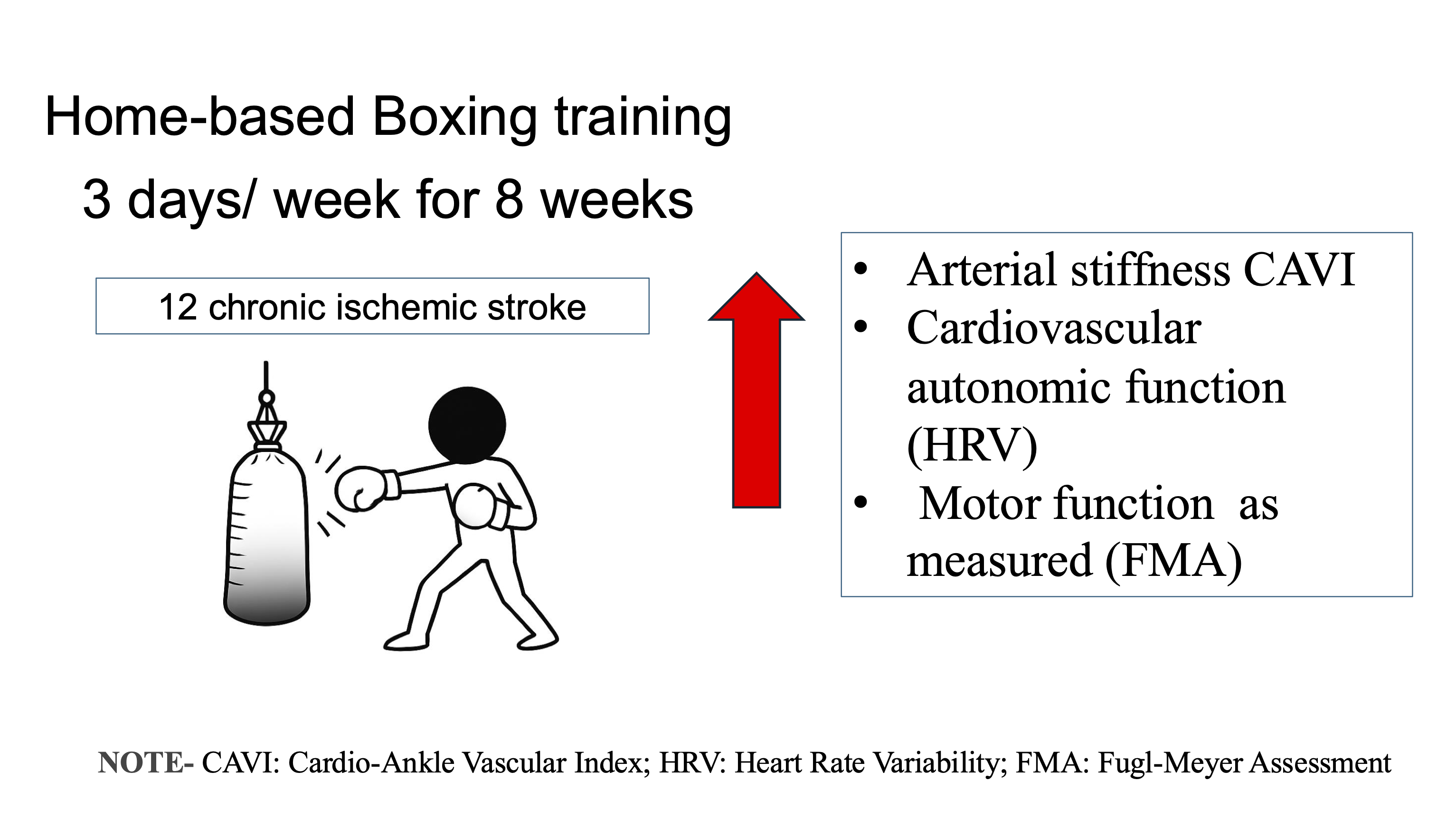
Aerobic exercise has demonstrated benefits in improving arterial stiffness, cardiovascular autonomic function, and motor performance in individuals with stroke. While exergames such as the Wii boxing game have shown potential to enhance cardiovascular fitness, their accessibility may be limited due to technological or equipment constraints. As an alternative, a home-based boxing program may serve as a practical intervention to improve atherosclerosis-related outcomes and autonomic nervous system function in stroke survivors. This study aimed to investigate the effects of moderate-intensity boxing training on arterial stiffness, arterial obstruction, autonomic function, and motor impairments in individuals with chronic ischemic stroke. This study employed a single-cohort feasibility design and was conducted in a community-based setting in Mueang District, Phitsanulok, Thailand. It involved 12 stroke survivors with a mean post-stroke duration of 25.4 months. Participants engaged in 24 one-hour boxing sessions over an 8-week period. Outcome measures included the Cardio-Ankle Vascular Index (CAVI), Ankle-Brachial Index (ABI), Heart Rate Variability (HRV), and Fugl-Meyer Assessment (FMA), evaluated at baseline, 4 weeks, and 8 weeks. Significant improvements were observed in CAVI values on both sides, with reductions from 9.55 to 8.45 (right) and from 9.30 to 8.60 (left) (p = 0.001). HRV analysis showed enhanced autonomic function, with increases in LFnu from 32.75 to 41.96 and LF/HF ratio from 0.51 to 0.99 (p = 0.017). Motor performance, as measured by the FMA, significantly improved from 80 to 96 (p = 0.001), while ABI values remained unchanged. These findings suggest that an accessible, moderate-intensity boxing program may be an effective strategy for supporting vascular health, autonomic regulation, and motor recovery in chronic stroke rehabilitation.
References
Al-Qudah, Z. A., Yacoub, H. A., & Souayah, N. (2015). Disorders of the autonomic nervous system after hemispheric cerebrovascular disorders: An update. Journal of Vascular and Interventional Neurology, 8(4), 43–52.
Alt Murphy, M., Resteghini, C., Feys, P., & Lamers, I. (2015). An overview of systematic reviews on upper extremity outcome measures after stroke. BMC Neurology, 15(1), Article 29. https://doi.org/10.1186/s12883-015-0292-6
American College of Sports Medicine. (2013). ACSM's guidelines for exercise testing and prescription. Philadelphia, US: Lippincott williams & wilkins.
Billinger, S. A., Arena, R., Bernhardt, J., Eng, J. J., Franklin, B. A., Johnson, C. M., ... & Tang, A. (2014). Physical activity and exercise recommendations for stroke survivors: A statement for healthcare professionals from the American Heart Association/American Stroke Association. Stroke, 45(8), 2532-2553. https://doi.org/10.1161/STR.0000000000000022
Billinger, S. A., Mattlage, A. E., Ashenden, A. L., Lentz, A. A., Harter, G., & Rippee, M. A. (2012). Aerobic exercise in subacute stroke improves cardiovascular health and physical performance. Journal of Neurologic Physical Therapy, 36(4), 159-165. https://doi.org/10.1097/NPT.0b013e318274d082
Chaabène, H., Tabben, M., Mkaouer, B., Franchini, E., Negra, Y., Hammami, M., ... & Hachana, Y. (2015). Amateur boxing: Physical and physiological attributes. Sports Medicine, 45(3), 337-352. https://doi.org/10.1007/s40279-014-0274-7
Chen, C. F., Lin, H. F., Lin, R. T., Yang, Y. H., & Lai, C. L. (2013). Relationship between ischemic stroke location and autonomic cardiac function. Journal of Clinical Neuroscience, 20(3), 406-409. https://doi.org/10.1016/j.jocn.2012.02.047
Chen, Z., Venkat, P., Seyfried, D., Chopp, M., Yan, T., & Chen, J. (2017). Brain–heart interaction: Cardiac complications after stroke. Circulation Research, 121(4), 451-468. https://doi.org/10.1161/CIRCRESAHA.117.311170
Cramer, S. C. (2008). Repairing the human brain after stroke: I. Mechanisms of spontaneous recovery. Annals of Neurology, 63(3), 272-287. https://doi.org/10.1002/ana.21393
Feigin, V. L., Stark, B. A., Johnson, C. O., Roth, G. A., Bisignano, C., Abady, G. G., ... & Hamidi, S. (2021). Global, regional, and national burden of stroke and its risk factors, 1990–2019: A systematic analysis for the Global Burden of Disease Study 2019. The Lancet Neurology, 20(10), 795-820. https://doi.org/10.1016/S1474-4422(21)00252-0
Gladstone, D. J., Danells, C. J., & Black, S. E. (2002). The Fugl-Meyer assessment of motor recovery after stroke: A critical review of its measurement properties. Neurorehabilitation and Neural Repair, 16(3), 232-240. https://doi.org/10.1177/154596802401105171
Guan, L., Collet, J. P., Mazowita, G., & Claydon, V. E. (2018). Autonomic nervous system and stress to predict secondary ischemic events after transient ischemic attack or minor stroke: Possible implications of heart rate variability. Frontiers in Neurology, 9, Article 90. https://doi.org/10.3389/fneur.2018.00090
Hong, J. B., Leonards, C. O., Endres, M., Siegerink, B., & Liman, T. G. (2016). Ankle-brachial index and recurrent stroke risk: Meta-analysis. Stroke, 47(2), 317-322. https://doi.org/10.1161/STROKEAHA.115.011321
Julious, S. A. (2005). Sample size of 12 per group rule of thumb for a pilot study. Pharmaceutical Statistics: The Journal of Applied Statistics in the Pharmaceutical Industry, 4(4), 287-291. https://doi.org/10.1002/pst.185
Kazmi, S. Z. H., Zhang, H., Aziz, W., Monfredi, O., Abbas, S. A., Shah, S. A., ... & Butt, W. H. (2016). Inverse correlation between heart rate variability and heart rate demonstrated by linear and nonlinear analysis. PloS One, 11(6), Article e0157557. https://doi.org/10.1371/journal.pone.0157557
Kelley, G. A., Kelley, K. A., & Vu Tran, Z. (2001). Aerobic exercise and resting blood pressure: A meta‐analytic review of randomized, controlled trials. Preventive Cardiology, 4(2), 73-80. https://doi.org/10.1111/j.1520-037X.2001.00529.x
Kerdsawatmongkon, J., Nualnetr, N., Isariyapan, O., Kitreerawutiwong, N., & Srisoparb, W. (2023). Effects of home-based boxing training on trunk performance, balance, and enjoyment of patients with chronic stroke. Annals of Rehabilitation Medicine, 47(1), 36-44. https://doi.org/10.5535/arm.22127
Khan, T. H., Farooqui, F. A., & Niazi, K. (2008). Critical review of the ankle brachial index. Current Cardiology Reviews, 4(2), 101-106. https://doi.org/10.2174/157340308784245810
Kleiger, R. E., Stein, P. K., & Bigger Jr, J. T. (2005). Heart rate variability: Measurement and clinical utility. Annals of Noninvasive Electrocardiology, 10(1), 88-101. https://doi.org/10.1111/j.1542-474X.2005.10101.x
Korpelainen, J. T., Sotaniemi, K. A., Huikuri, H. V., & Myllylä, V. V. (1996). Abnormal heart rate variability as a manifestation of autonomic dysfunction in hemispheric brain infarction. Stroke, 27(11), 2059-2063. https://doi.org/10.1161/01.STR.27.11.2059
Lee, H. S., Lee, H. L., Han, H. S., Yeo, M., Kim, J. S., Lee, S. H., ... & Shin, D. I. (2016). Clinical usefulness of ankle brachial index and brachial-ankle pulse wave velocity in patients with ischemic stroke. Journal of Biomedical Research, 30(4), 285-291. https://doi.org/10.7555/JBR.30.2016K0006
Lee, Y. H., Park, S. H., Yoon, E. S., Lee, C. D., Wee, S. O., Fernhall, B., & Jae, S. Y. (2015). Effects of combined aerobic and resistance exercise on central arterial stiffness and gait velocity in patients with chronic poststroke hemiparesis. American Journal of Physical Medicine & Rehabilitation, 94(9), 687-695. https://doi.org/10.1097/PHM.0000000000000233
McClary, K. N., & Massey, P. (2025). Ankle Brachial Index. Florida, United States: StatPearls Publishing LLC.
Nystoriak, M. A., & Bhatnagar, A. (2018). Cardiovascular effects and benefits of exercise. Frontiers in Cardiovascular Medicine, 5, Article 408204. https://doi.org/10.3389/fcvm.2018.00135
Ogliari, G., Mahinrad, S., Stott, D. J., Jukema, J. W., Mooijaart, S. P., Macfarlane, P. W., ... & Sabayan, B. (2015). Resting heart rate, heart rate variability and functional decline in old age. Canadian Medical Association Journal, 187(15), E442-E449. https://doi.org/10.1503/cmaj.150462
Orini, M., van Duijvenboden, S., Young, W. J., Ramírez, J., Jones, A. R., Hughes, A. D., ... & Lambiase, P. D. (2023). Long-term association of ultra-short heart rate variability with cardiovascular events. Scientific Reports, 13(1), Article 18966. https://doi.org/10.1038/s41598-023-45988-2
Page, S. J., Hade, E., & Persch, A. (2015). Psychometrics of the wrist stability and hand mobility subscales of the Fugl-Meyer assessment in moderately impaired stroke. Physical Therapy, 95(1), 103-108. https://doi.org/10.2522/ptj.20130235
Pandian, S., Arya, K. N., & Kumar, D. (2016). Minimal clinically important difference of the lower-extremity fugl–meyer assessment in chronic-stroke. Topics in Stroke Rehabilitation, 23(4), 233-239. https://doi.org/10.1179/1945511915Y.0000000003
Park, J., Gong, J., & Yim, J. (2017). Effects of a sitting boxing program on upper limb function, balance, gait, and quality of life in stroke patients. NeuroRehabilitation, 40(1), 77-86. https://doi.org/10.3233/NRE-161392
Raimundo, R. D., Zangirolami-Raimundo, J., Leone, C., de Carvalho, T. D., da Silva, T. D., Bezerra, I. M. P., ... & de Abreu, L. C. (2021). The use of cardiac autonomic responses to aerobic exercise in elderly stroke patients: Functional rehabilitation as a public health policy. International Journal of Environmental Research and Public Health, 18(21), Article 11460. https://doi.org/10.3390/ijerph182111460
Sampaio, L. M. M., Subramaniam, S., Arena, R., & Bhatt, T. (2016). Does virtual reality-based kinect dance training paradigm improve autonomic nervous system modulation in individuals with chronic stroke?. Journal of Vascular and Interventional Neurology, 9(2), 21-29.
Shaffer, F., & Ginsberg, J. P. (2017). An overview of heart rate variability metrics and norms. Frontiers in Public Health, 5, Article 258. https://doi.org/10.3389/fpubh.2017.00258
Shaffer, F., Meehan, Z. M., & Zerr, C. L. (2020). A critical review of ultra-short-term heart rate variability norms research. Frontiers in Neuroscience, 14, Article 594880. https://doi.org/10.3389/fnins.2020.594880
Shirai, K., Hiruta, N., Song, M., Kurosu, T., Suzuki, J., Tomaru, T., ... & Takata, M. (2011). Cardio-ankle vascular index (CAVI) as a novel indicator of arterial stiffness: Theory, evidence and perspectives. Journal of Atherosclerosis and Thrombosis, 18(11), 924-938. https://doi.org/10.5551/jat.7716
Shirai, K., Utino, J., Otsuka, K., & Takata, M. (2006). A novel blood pressure-independent arterial wall stiffness parameter; cardio-ankle vascular index (CAVI). Journal of Atherosclerosis and Thrombosis, 13(2), 101-107. https://doi.org/10.5551/jat.13.101
Su, N., Zhai, F. F., Ni, J., Zhou, L. X., Yao, M., Peng, B., ... & Cui, L. Y. (2017). Pulse pressure within 3 months after ischemic stroke is associated with long-term stroke outcomes. American Journal of Hypertension, 30(12), 1189-1195. https://doi.org/10.1093/ajh/hpx121
Suetake, V. Y., Franchini, E., Saraiva, B. T., Da Silva, A. K., Bernardo, A. F., Gomes, R. L., ... & Christofaro, D. G. (2018). Effects of 9 months of martial arts training on cardiac autonomic modulation in healthy children and adolescents. Pediatric Exercise Science, 30(4), 487-494. https://doi.org/10.1123/pes.2017-0083
Sun, C. K. (2013). Cardio-ankle vascular index (CAVI) as an indicator of arterial stiffness. Integrated Blood Pressure Control, 27-38. https://doi.org/10.2147/IBPC.S34423
Suzuki, J., Sakakibara, R., Tomaru, T., Tateno, F., Kishi, M., Ogawa, E., ... & Shirai, K. (2013). Stroke and cardio-ankle vascular stiffness index. Journal of Stroke and Cerebrovascular Diseases, 22(2), 171-175. https://doi.org/10.1016/j.jstrokecerebrovasdis.2011.07.010
Sztajzel, J. (2004). Heart rate variability: A noninvasive electrocardiographic method to measure the autonomic nervous system. Swiss Medical Weekly, 134(3536), 514-522. https://doi.org/10.4414/smw.2004.10321
Takatori, K., Matsumoto, D., Okada, Y., Nakamura, J., & Shomoto, K. (2012). Effect of intensive rehabilitation on physical function and arterial function in community-dwelling chronic stroke survivors. Topics in Stroke Rehabilitation, 19(5), 377-383. https://doi.org/10.1310/tsr1905-377
Tanaka, H. (2019). Antiaging effects of aerobic exercise on systemic arteries. Hypertension, 74(2), 237-243. https://doi.org/10.1161/HYPERTENSIONAHA.119.13179
Thai Cognitive Test Development Committee. (2002). Mini-mental state examination-Thai 2002. Bangkok, Thailand: Institute of Geriatric Medicine, Department of Medical Services, Ministry of Public Health.
Thomson, E., Lamb, K., & Nicholas, C. (2013). The development of a reliable amateur boxing performance analysis template. Journal of Sports Sciences, 31(5), 516-528. https://doi.org/10.1080/02640414.2012.738922
Trinh, T., Scheuer, S. E., Thompson-Butel, A. G., Shiner, C. T., & McNulty, P. A. (2016). Cardiovascular fitness is improved post-stroke with upper-limb Wii-based Movement Therapy but not dose-matched constraint therapy. Topics in Stroke Rehabilitation, 23(3), 208-216. https://doi.org/10.1080/10749357.2016.1138672
Woolley, B., Stoner, L., Lark, S., Wong, L., Lanford, J., & Faulkner, J. (2015). Effect of early exercise engagement on arterial stiffness in patients diagnosed with a transient ischaemic attack. Journal of Human Hypertension, 29(2), 87-91. https://doi.org/10.1038/jhh.2014.56
Zhang, D., Lu, Y., Zhao, X., Zhang, Q., & Li, L. (2020). Aerobic exercise attenuates neurodegeneration and promotes functional recovery–Why it matters for neurorehabilitation & neural repair. Neurochemistry International, 141, Article 104862. https://doi.org/10.1016/j.neuint.2020.104862
Zhang, H., Xie, Q., & Hu, J. (2022). Neuroprotective effect of physical activity in ischemic stroke: Focus on the neurovascular unit. Frontiers in Cellular Neuroscience, 16, Article 860573. https://doi.org/10.3389/fncel.2022.860573
Downloads
Published
How to Cite
Issue
Section
License
Copyright (c) 2025 Journal of Current Science and Technology

This work is licensed under a Creative Commons Attribution-NonCommercial-NoDerivatives 4.0 International License.