Utilization of Spent Mushroom Substrate for Biomass Fuel Pellets Production: Effect of Moisture Content on Pelletization
Keywords:
Spent Mushroom Substrate, Biomass Pellet, Waste ManagementAbstract
Background and Objectives: Spent mushroom substrate (SMS) is an agricultural byproduct generated in large quantity from mushroom cultivation, posing environmental concerns if not properly managed. Converting SMS into biomass pellets presents a sustainable waste management approach that enhances resource utilization and supports circular bioeconomy principles. However, moisture content significantly affects the pelletization process and the final product quality. This study aimed to investigate the impact of moisture content level on the production efficiency and quality of biomass pellets derived from SMS, focusing on bulk density, mechanical durability, calorific value and specific energy consumption.
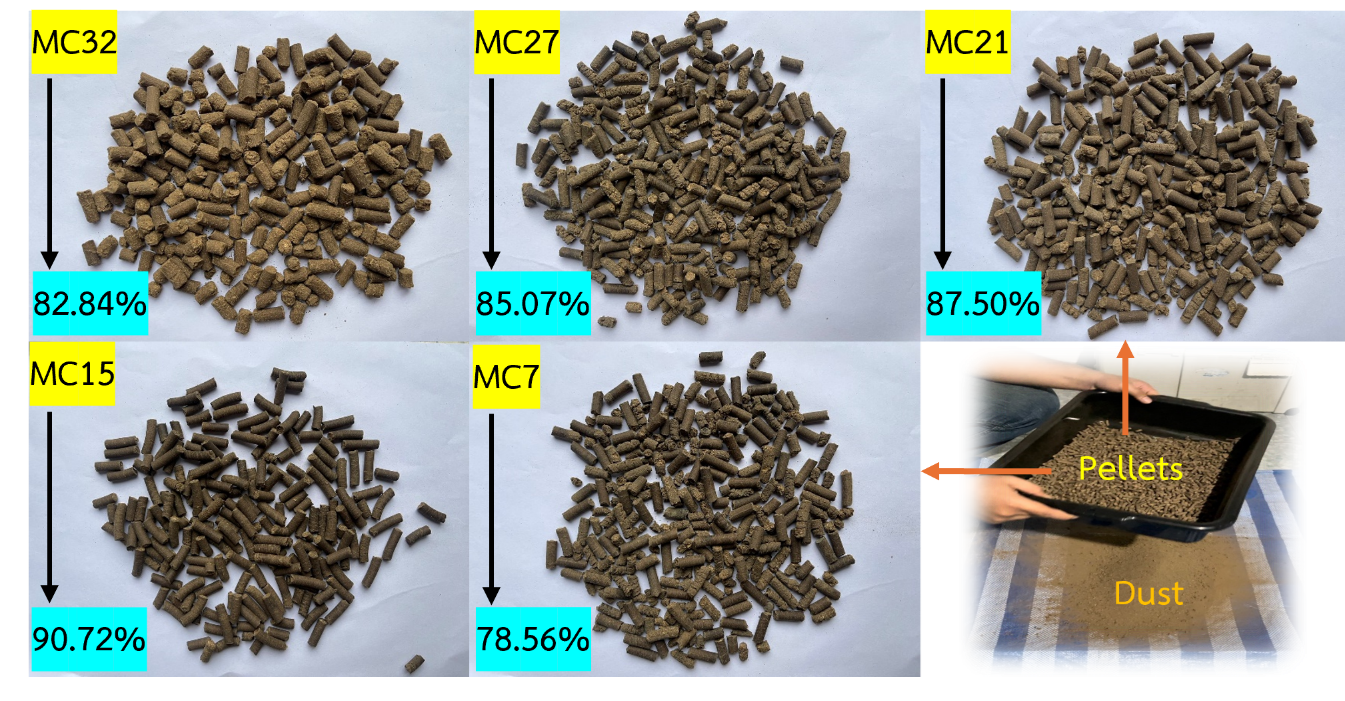
Methodology: SMS obtained from mushroom farms in Thailand was utilized. The substrate was sun-dried for 1, 3, 6, 7, and 9 days to achieve different moisture content levels, i.e., MC32 (31.52%), MC27 (27.05%), MC21 (21.41%), MC15 (15.23%) and MC8 (7.77%), respectively. Each dried substrate was pelletized using a rotary die pellet mill with a die diameter of 6 mm. The produced biomass pellets were evaluated for several properties, including production efficiency, pellet formation capacity, dimensional characteristics, bulk density, mechanical durability and calorific value. All results were compared with relevant standards to determine the optimal moisture content for biomass pellets production.
Main Results: Moisture content significantly influenced both production efficiency and pellet quality. High moisture content (MC32) resulted in the highest production rate (27.78 kg/hr) and the lowest energy consumption (92.26 Whr/kg); mechanical durability of the pellets was nevertheless below the standard value. Conversely, low moisture content (MC8) provided pellets with sufficient durability, but resulted in low production efficiency and the lowest pellet formation percentage (78.56%). The optimal moisture content range was MC15–MC21, which resulted in high pellet formation (90.72%), maximum mechanical durability (97.79%) and bulk density of 540–568 kg/m³, aligning with EN ISO 17225-6 standards, although slightly below the Thai Industrial Standard TIS 2772-2560 for bulk density. The calorific value ranged from 14.63–14.68 MJ/kg, exceeding all minimum standard requirements.
Conclusions: Production of biomass fuel pellets from SMS is plausible, with moisture content playing a crucial role in determining the pellet quality. Moderate moisture levels (15–21%) were found to be optimal for pelletization as they enhance pellets formation, mechanical durability and bulk density, while also providing calorific values that meet standard requirements. Controlling the moisture content of a raw material is a key strategy for improving the pellets production process from this type of agricultural waste.
Practical Application: Utilizing SMS as a raw material for the production of biomass pellets as an alternative renewable energy source exhibits potential for the reduction of waste from the mushroom cultivation industry. The present study provides a guideline for improving the efficiency of biomass pellets production and may be extended to other agricultural residues in the future. Furthermore, it aligns with the principles of circular economy by promoting efficient resource utilization.
References
Kalpana, M., Balakrishnan, N., Rajavel, M. and Divya, M. 2024. A Review on economic viability and challenges in mushroom agribusiness in Tamil Nadu, India. Asian Journal of Current Research, 9, 135-142.
Chang, B.V., Yang, C.P. and Yang, C.W. 2021. Application of fungus enzymes in spent mushroom composts from edible mushroom cultivation for phthalate removal. Microorganisms, 9, 1989.
a Silva Alves, L., de Almeida Moreira, B.R., da Silva Viana, R., Pardo-Gimenez, A., Dias, E.S., Noble, R. and Zied, D.C. 2021. Recycling spent mushroom substrate into fuel pellets for low-emission bioenergy producing systems. Journal of Cleaner Production, 313, 127875.
Li, X., Chen, G., Li, X. and Yao, F. 2023. Three pleurotus mushroom species cultivated in a mixed phragmites australis substrate differ in nutrient utilization capacity. Journal of Food Composition and Analysis, 115, 104924.
Miah, M.N., Begum, A., Shelly, N.J., Bhattacharjya, D.K., Paul, R.K. and Kabir, M.H. 2017. Effect of different sawdust substrates on the growth, yield and proximate composition of white oyster mushroom (Pleurotus ostreatus). Bioresearch Communications (BRC), 3, 397-410.
Ngan, N.M. and Riddech, N. 2021. Use of spent mushroom substrate as an inoculant carrier and an organic fertilizer and their impacts on roselle growth (Hibiscus sabdariffa L.) and Soil Quality. Waste and Biomass Valorization, 12, 3801-3811.
Kamal Baharin, N.S., Koesoemadinata, V.C., Nakamura, S., Azman, N.F., Muhammad Yuzir, M.A., Md Akhir, F.N., Iwamoto, K., Yahya, W.J., Othman, N., Ida, T. and Hara, H. 2020. Production of bio-coke from spent mushroom substrate for a sustainable solid fuel. Biomass Conversion and Biorefinery, 12, 4095-4104.
Rangubhet, K.T., Mangwe, M.C., Mlambo, V., Fan, Y.K. and Chiang, H.I. 2017. Enteric methane emissions and protozoa populations in Holstein steers fed spent mushroom (Flammulina velutipes) substrate silage-based diets. Animal Feed Science and Technology, 234, 78-87.
Ma, X., Yan, S. and Wang, M. 2025. Spent mushroom substrate: A review on present and future of green applications. Journal of Environmental Management, 373, 123970.
Sui, H., Chen, J., Cheng, W., Zhu, Y., Zhang, W., Hu, J., Jiang, H., Shao, J. and Chen, H. 2024. Effect of oxidative torrefaction on fuel and pelletizing properties of agricultural biomass in comparison with non-oxidative torrefaction. Renewable Energy, 226, 120423.
Nath, B., Chen, G., Bowtell, L. and Nguyen-Huy, T. 2025. Enhancement of wheat straw pellet quality for bioenergy through additive blending. Journal of the Air & Waste Management Association, 75, 387-404.
Jagtap, A. and Kalbande, S. 2023. Effect of moisture content and particle size on characteristics of fuel pellets using flat die type pelleting machine. International Journal of Environment and Climate Change, 13, 174-182.
Yılmaz, H., Topakcı, M., Çanakcı, M. and Karayel, D. 2022. Effect of die geometry and moisture content on pelletizing of palm pruning residues. Tekirdağ Ziraat Fakültesi Dergisi, 19, 204-214.
Nguyen, Q.N., Cloutier, A., Stevanovic, T. and Achim, A. 2017. Pressurized hot water treatment of sugar maple and yellow birch wood particles for high quality fuel pellet production. Biomass and Bioenergy, 98, 206-213.
Ungureanu, N., Vladut, V., Paraschiv, G., Ionescu, M., Zabava, B.S. and Grigore, I. 2016. Production status of biomass pellets–Review. Annals of the University of Craiova- Agriculture Montanology Cadastre Series, 46, 574-581.
Jiang, X., Cheng, W., Liu, J., Xu, H., Zhang, D., Zheng, Y. and Cai, H. 2020. Effect of moisture content during preparation on the physicochemical properties of pellets made from different biomass materials. BioResources, 15, 557.
Matúš, M., Križan, P., Šooš, L.U. and Beniak, J. 2015. Effects of initial moisture content on the physical and mechanical properties of Norway Spruce Briquettes. International Journal of Environmental and Ecological Engineering, 9, 1227-1233.
Triatmoko, J., Arifin, F. and Bow, Y. 2023. Comparison moisture of biopellet from sugarcane bagasse and coconut dregs as raw materials for co-firing power plant. Journal of Mechanical, Civil and Industrial Engineering, 4, 34-39.
Sadeq, A., Frank, A., Tyslik, M., Jägers, J., Pietsch-Braune, S., Scherer, V. and Heinrich, S. 2023. Influence of cyclic water content changes during long-term storage on the mechanical stability of wood pellets. Powder Technology, 428, 118866.
Rosales-Serna, R., Carrillo-Parra, A., Ríos-Saucedo, J.C., Reyes-Jáquez, D., Sierra-Zurita, D., Santana-Espinoza, S., Jiménez-Ocampo, R., Domínguez-Martínez, P.A. and Nava-Berumen, C.A. 2024. Biomass densification to improve management efficiency and to obtain high value products in México. Resources, 13, 48.
Zulkornain, M.F., Mohd Rawian, N.A., Neshaeimoghaddam, H., Shamsuddin, A.H., Md Saad, J., Abd Rahman, A., Samsuri, S. and Naning, F.H. 2022. Influence of organic binder and moisture content on the durability of rice husk and rice straw-based pellets. International Journal of Applied Science and Engineering, 19, 1-6.
Xu, X., Yu, G., Wang, J., Xu, X., Zhang, W. and Xu, Y. 2024. Study on preparation technology of high-quality biomass fuel pellets using Caragana korshinskii Kom. Powder. Wood Research, 69, 157-168.
Scott, C., Desamsetty, T.M. and Rahmanian, N. 2024. Unlocking power: Impact of physical and mechanical properties of biomass wood pellets on energy release and carbon emissions in power sector. Waste and Biomass Valorization, 16, 441-458.
Styks, J., Knapczyk, A. and Łapczyńska-Kordon, B. 2021. Effect of compaction pressure and moisture content on post-agglomeration elastic springback of pellets. Materials, 14, 879.
Lee, J.S., Sokhansanj, S., Lau, A.K., Lim, J. and Bi, X.T. 2021. Moisture adsorption rate and durability of commercial softwood pellets in a humid environment. Biosystems Engineering, 203, 1-8.
Tumuluru, J.S., Rajan, K., Hamilton, C., Pope, C., Rials, T.G., McCord, J., Labbé, N. and André, N.O. 2022. Pilot-scale pelleting tests on high-moisture pine, switchgrass, and their blends: Impact on pellet physical properties, chemical composition, and heating values. Frontiers in Energy Research, 9, 788284.
Gorzelany, J., Zardzewiały, M., Murawski, P. and Matłok, N. 2020. Analysis of selected quality features of wood pellets. Agricultural Engineering, 24, 25-34.
Marian, G., Gelu, I., Gudîma, A., Nazar, B., Istrate, B., Banari, A., Pavlenco, A. and Daraduda, N. 2023. Calorific value of pellets produced from raw material collected from both sides of the river Prut. Journal of Engineering Science, 29, 126-13.
Downloads
Published
How to Cite
Issue
Section
License
Copyright (c) 2025 King Mongkut's University of Technology Thonburi

This work is licensed under a Creative Commons Attribution-NonCommercial-NoDerivatives 4.0 International License.
Any form of contents contained in an article published in Science and Engineering Connect, including text, equations, formula, tables, figures and other forms of illustrations are copyrights of King Mongkut's University of Technology Thonburi. Reproduction of these contents in any format for commercial purpose requires a prior written consent of the Editor of the Journal.