
Development of an Anti-Bedsore Bed with Alternating Pressure Points and a Sub-Bed PID-Controlled Cooling System
Keywords:
Bedsore, Anti-Bedsore Bed, Alternating Pressure Points, PID ControlAbstract
Background and Objectives: Bedsores are injuries caused by the death of skin cells and underlying tissues due to prolonged pressure on specific parts of the body, which reduces blood circulation to those areas and results in insufficient oxygen supply to the tissues. Additionally, moisture combined with long-term pressure can cause skin maceration, making it more susceptible to developing bedsores. If the condition becomes severe and bacteria enter the wound, causing an infection, it becomes difficult to treat and poses a risk of death from septicemia. Therefore, the present research aimed to design and develop an anti-bedsore bed, as well as to evaluate its efficiency.
Methodology: This research was divided into two phases. The first involved designing an Anti-Bedsore Bed based on the principle of alternating weight-bearing points to distribute pressure, which is the primary cause of bedsores, while the second phase focused on performance testing. The evaluation included a load-bearing test where test objects were placed on the mattress base with weight increments of 50 kg up to 150 kg, maintaining each load for 8 hours to study the deflection of the mattress base. Additionally, an under-bed cooling system was tested at a simulated ambient temperature of 33 °C to identify the optimal parameters ( and ) for achieving a rapid temperature response toward a target temperature of 28 °C. Finally, user perception was assessed by having 40 healthy volunteers, categorized by gender and BMI, lying on the Anti-Bedsore Bed for 30 minutes during the operation; data were collected through structured interviews covering their awareness of the bed’s alternating movement, vibrations during operation, physical discomfort, and heat sensation at the skin-mattress contact area.
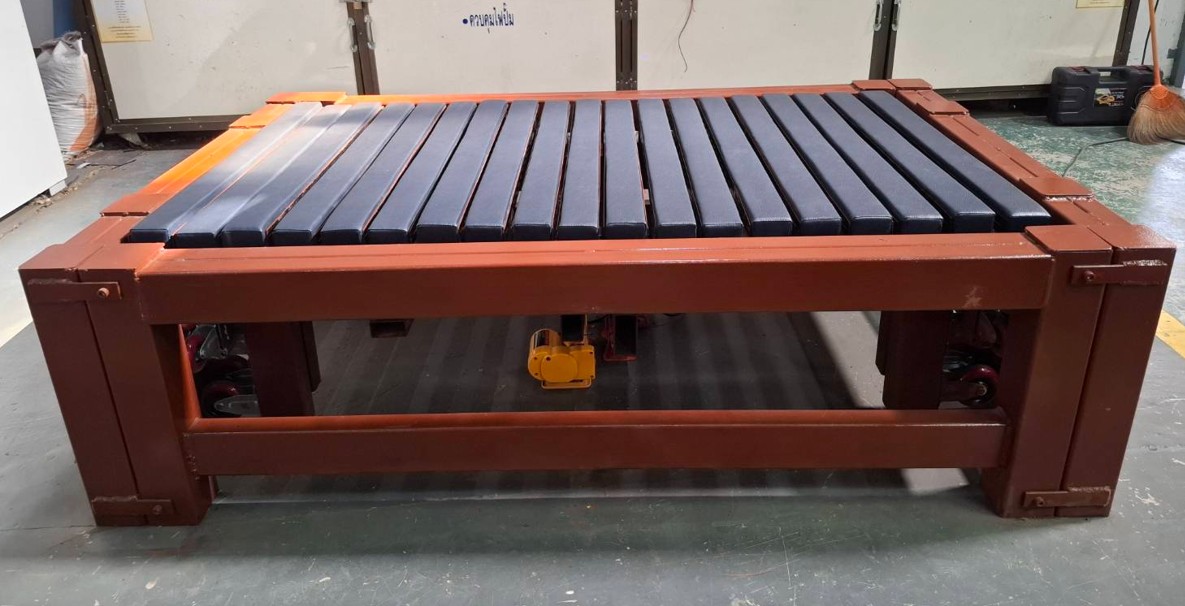
Main Results: The Anti-Bedsore Bed is divided into three primary sections, namely, a stationary outer frame composing of pillars and beams that support the inner structure and utilize limit switches to regulate movement of the inner bed; a mobile inner bed featuring two sets of interleaved mattress bases that move vertically in alternating loops to distribute the patient’s body weight at set intervals; a cooling unit installed beneath the bed that employs a PID (closed-loop) controller system to adjust fan speed for optimal patient comfort and sweat reduction. Performance testing demonstrated that the mattress base maintained a deflection of 0.236 mm under a maximum load test of 150 kg, while the PID-controlled cooling system achieved its best performance with parameters and set to 90, 15, and 0.1, respectively, resulting in a response slope of -0.101 ºC/s and a steady-state error of only 0.25 ºC. Furthermore, subjective evaluations from healthy volunteers indicate that the physical sensation or discomfort experienced while lying on the shifting mattress bases remained at a low level.
Conclusions: The Anti-Bedsore Bed is composed of three primary elements, i.e., a fixed outer frame, a movable inner frame, and a specialized cooling system, all of which function by alternating pressure points through two sets of mattress bases that interchangeably shift upward and downward. This equipment can support a maximum load of 150 kg and is engineered to rapidly lower and stabilize the ambient air temperature beneath the bed without significant fluctuations. Clinical trials involving volunteers indicate that while both male and female users perceived the mechanical movements at a similarly low level, individuals with Body Mass Index (BMI) over 30 reported more extensive heat and discomfort compared to other groups, a result attributed to their physiological tendency to accumulate more body heat.
Practical Application: An Anti-Bedsore Bed prototype has been developed to benefit bedridden patients by effectively reducing the occurrence of bedsores.
References
Sirimahachaiyakul, P. and Chiraworaphat, S. 2024. Collective review: Pressure ulcer. Thai Journal of Burn and Wound Healing, 5, 55-77. (In Thai)
Chularee, S., Chiaranai, C., Phetrot, S. and Chatphimai, D. 2023. Caring for critically Ill patients with hospital-acquired pressure injuries: The role of critical care nurses. Journal of Health and Nursing Education, 29, 1-15. (In Thai)
Utthiya, P. 2023. Roles of home health care nurses in prevention & care for patients with pressure injury at home: The experience of Ramathibodi Hospital. Journal of Health and Nursing Research, 39, 12-21. (In Thai)
Department of Health. 2024. Percentage of elderly people with dependency receiving care according to the care plan. Ministry of Public Health [Online]. Available: https://dashboard.anamai.moph.go.th/dashboard/agedcareplan/index?year=2024 [4 April 2026] (In Thai)
Chobchuen, R. 2013. Nursing care in pressure sore. Srinagarind Medical Journal, 28, 41-46. (In Thai)
Ebrahim, J., Deribe, B., Biru, W.J. and Feleke, T. 2018. Prevalence and factors associated with pressure ulcer among patients admitted in Hawassa University Referral Hospital, South Ethiopia. Journal of Health Care and Prevention, 1, 1-7.
Khajavi, M., Raoufi, Z. and Abdollahi, S. 2025. Investigating the potential of collagen/ carrageenan trilayer sponges with optimal therapeutic and physical properties for the treatment of pressure ulcers. International Journal of Biological Macromolecules, 306, 141743. https://doi.org/10.1016/j.ijbiomac.2025.141743
Sukwasana, K., Prasertsri, S., Nahokham, M., Singweratham, N., Nawsuwan, K. and Khammathit, A. 2023. The effects of applying the 3-plus innovation to eliminate bed sore on reducing the severity of pressure sores and the satisfaction of innovative users in the female medicine unit, Thabo Crown Prince Hospital. Journal of Nursing and Public Health Research, 3, 48-61. (In Thai)
Komindr, S. 2001. Bed for Prevention and Treatment of Pressure Sores (Thai Patent No. 10591). Department of Intellectual Property. (In Thai)
Utyophas, Y. 2007. Anti-Bedsore Patient Bed (Thai Patent No. 21323). Department of Intellectual Property. (In Thai)
Kovitnawong, N., Somnukpong, S. and Rujapanmatee, M. 2021. Bed for Preventing Pressure Ulcers (Thai Petty Patent No. 17827). Department of Intellectual Property. (In Thai)
Sittisakuncharoen, S. 2017. Patient Turning Bed for Pressure Sore Prevention (Thai Petty Patent No. 13198). Department of Intellectual Property. (In Thai)
Methakanjanasak, N., Ruangsuksud, P., Changruang, O., Daochalermwong, S., Kaewnoi, K., Namwas, S., Suphrom, K., Wingwian, I., Boonjirapiphat, A., Thiabbokmai, S. and Sringkarn, P. 2023. Pressure Ulcer Prevention Bed (Thai Petty Patent No. 22231). Department of Intellectual Property. (In Thai)
Mamom, J. 2016. Electric Patient-Turning Bed with Handrails (Thai Petty Patent No. 11214). Department of Intellectual Property. (In Thai)
Nontakaew, U., Chiaranaisilawong, P., Srikitsuwarn, S., Soontornkiti, S., Chanpongsri, V., and Thanawatkosol, S. 2013. Bed Supplementary Mechanism for Pressure Sore Prevention by Weight-Shifting Method (Thai Petty Patent No. 8069). Department of Intellectual Property. (In Thai)
Pheetarakorn, P. 2021. Nursing care of the patients with pressure injury: Nurse’s role. Hua Hin Medical Journal, 1, 1-16. (In Thai)
International Electrotechnical Commission. 2026. Medical Electrical Equipment — Part 2-52: Particular Requirements for the Basic Safety and Essential Performance of Medical Beds for Adults (IEC Standard No. 80601-2-52:2026)
Halliday, D., Resnick, R. and Walker, J. 2018. Fundamentals of Physics. John Wiley & Sons, New Jersey.
Sirimahachaikul, P. and Chiravoraphan, S. 2021. Literature review: Pressure ulcer. Thai Journal of Burn and Wound Healing, 5, 55-77. (In Thai)
Blazejczyk, K., Epstein, Y., Jendritzky, G., Staiger, H. and Tinz, B. 2012. Comparison of UTCI to selected thermal indices. International Journal of Biometeorology, 56, 515–535. https://doi.org/10.1007/s00484-011-0453-2
International Electrotechnical Commission. 2005. Medical Electrical Equipment — Part 1: General Requirements for Basic Safety and Essential Performance (IEC 60601-1:2005).
McCormac, J.C. and Csernak, S.F. 2011. Structural Steel Design. Pearson, New Jersey.
Jitkhajornwanich, K. 2006. Shifting Comfort Zone for Hot-Humid Environments. The 23rd Conference on Passive and Low Energy Architecture. Geneva, Switzerland.
Taweekun, J. and Tantiwichien, A. 2013. Thermal comfort zone for Thai people. Engineering, 5, 525–529. https://doi.org/10.4236/eng.2013.55062
Zheng, G., Li, K. and Wang, Y. 2019. The effects of high temperature weather on human sleep quality and appetite. International Journal of Environmental Research and Public Health, 16, 270. https://doi.org/10.3390/ijerph16020270
Guarnieri, G., Olivieri, B., Senna, G. and Vianello, A. 2023. Relative humidity and iIts impact on the immune system and infections. International Journal of Molecular Sciences, 24, 9456. https://doi.org/10.3390/ijms24119456
Ogata, K. 2010. Modern Control Engineering, Prentice Hall, New Jersey.
Unhavanich, S. 2002. Control System, W. Phetsakun, Bangkok. (In Thai)
Threerapongphatthana, P. 2023. The factors predicting body mass index over the normal range of staff in Buddhachinaraj Phitsanulok Hospital. Department of Health Service Support Journal, 19, 27-36. (In Thai)
Silpcharu, T. 2010. Research and Statistical Data Analysis with SPSS. Business Research and Development Partnership, Bangkok. (In Thai)
Hibbeler, R.C. 2016. Mechanics of Materials. Pearson, New York.
Rodrigo, D.S. and Sewwandi, H.M.N. 2018. Comparison of deflection patterns of simply supported and fixed supported beam structures. International Journal of Advanced Engineering Research and Science, 5, 240–243. https://doi.org/10.22161/ ijaers.5.9.26
Valentina, P., Tjahjono, H., Pamitran, A.S., Roswandi, I., Setiawan, P.H., Budiman, A.A., Haryanto, D., Sanda, Prayogo, K. and Juarsa, M. 2025. Implementation of adaptive PID control for maintaining temperature stability during steady state conditions in stirred heating tank. International Journal of Power Electronics and Drive System (IJPEDS), 16, 2389–2399. https://doi.org/10.11591/ijpeds.v16.i4.pp2389-2399
Speakman, J.R. 2018. Obesity and Thermoregulation (pp. 431-443), in A.A. Romanovsky (Ed.) Handbook of Clinical Neurology, Thermoregulation: From Basic Neuroscience to Clinical Neurology Part I. Vol. 156, Elsevier, Amsterdam. https://doi.org/10.1016/ B978-0-444-63912-7.00026-6
He, M., Guo, J., Liu, H., Xiong, F., Zhou, S., Wu, Y., Li, B. and Kosonen, R. 2025. Does BMI affect thermal comfort in young people in warm indoor environments? Evidence from a climate chamber experiment in non-normal BMIs. Journal of Building Engineering, 106, 112618. https://doi.org/10.1016/j.jobe.2025.112618
Downloads
Published
How to Cite
Issue
Section
License
Copyright (c) 2026 King Mongkut's University of Technology Thonburi

This work is licensed under a Creative Commons Attribution-NonCommercial-NoDerivatives 4.0 International License.
Any form of contents contained in an article published in Science and Engineering Connect, including text, equations, formula, tables, figures and other forms of illustrations are copyrights of King Mongkut's University of Technology Thonburi. Reproduction of these contents in any format for commercial purpose requires a prior written consent of the Editor of the Journal.