
Spatial-Spectral Deep Transfer Learning Network for Few-Shot Hyperspectral Image Classification
Keywords:
Contrastive Learning, Few-Shot Learning, Hyperspectral Image Classification, Spatial–Spectral Features, Transfer LearningAbstract
Background and Objectives: In recent decades, classification of hyperspectral images (HSIs) has made significant progress with the development of deep learning (DL). However, learning with a few samples remains a difficulty due to the high cost of annotating samples and potential errors in manual evaluation. Most DL-related methods require a sufficient number of annotated samples to learn the intricate spatial-spectral structure and spectrum of HSI data, making them unsuitable for practical situations with limited samples. To overcome the difficulty in learning with a few samples, we propose a deep transfer contrastive learning approach known as Spatial–Spectral Deep Transfer Learning Network (SSDTLN) for HSI classification. The proposed approach utilizes a spectral augmentation process to increase the diversity of pairs of samples with diverse characteristics. In addition, a spatial feature extraction component is incorporated to leverage complementary information by supporting the spatial component with pretrained representations from the source domain and the spectral residual component, focusing on precise spectral feature extraction. Moreover, contrastive learning can increase the discriminative ability of the representations with the goal of improving the ability to deal with tasks concerning high similarities between classes and large variances within classes with few samples.
Methodology: The proposed approach involved a spatial-spectral few-shot deep transfer learning approach for the classification of hyperspectral images, which was broken down into three broad phases: spatial feature extraction via a CNN-based spatial network pre-trained on the ImageNet dataset; spectral feature extraction via a residual convolutional network coupled with spectral enhancement techniques such as random spectral shift and Gaussian noise injection; spatial-spectral feature fusion via convolutional layers; and a spatial attention module (SAM). Hyperspectral image patches were then created and arranged in a C-way K-shot episode, where the labeled images comprised the support set, while the remaining comprised the query set. A mapping layer was applied for projecting the high-dimensional hyperspectral image data into a three-channel format, compatible with the spatial network. Finally, the classification was conducted via a nearest-neighbor classifier, while the optimization of the approach was conducted via a joint loss function that combined cross-entropy loss and a supervised contrastive loss.
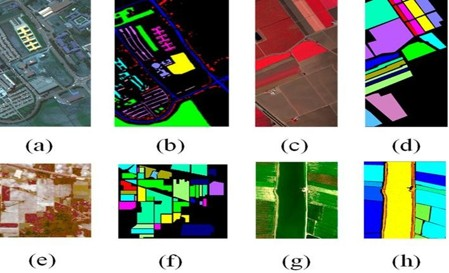
Main Results: The quantitative and qualitative analysis of the proposed and other state-of-the-art techniques like SVM, SSRN, DFSL, S3Net, HTLN, DCLN, and CPPM are validated on four benchmark hyperspectral image (HSI) datasets known as Pavia University (PU) dataset, Salinas (SA) dataset, Indian Pines (IP) dataset, and LongKou (LK) dataset. Experimental results indicate that the proposed model outperformes other techniques in terms of classification accuracy, boundary identification, and generalization ability, using minimal samples, while also having acceptable complexity.
Conclusions: This work successfully addresses its goal of designing a strong few-shot classification framework for hyperspectral images (HSIs) leveraging deep transfer learning and contrastive learning methods. The proposed model effectively boosts feature learning by leveraging the strengths of ImageNet-pretrained spatial networks, spectral residual learning, and spectral data augmentation methods. Additionally, the Spatial Attention Module (SAM) helps better capture the context at multiple scales, especially in boundary regions. Finally, the hybrid loss function further promotes inter-class distinction and decreases intra-class variations. Experiments conducted on four popular HSI datasets validate the superior accuracy and generalization performance of the proposed approach in few-shot learning scenarios. Even though the approach is effective, there are some issues related to computational complexity and adaptability for low-resolution and cross-sensor learning that show promising research directions.
Practical Application: The findings of this study can be effectively used in real-world applications of hyperspectral image analysis when there is a lack of annotated data, including precision farming, environmental studies, urban planning, mineral exploration, and disaster response. The developed few-shot learning framework can be effectively used for land cover mapping with only a few training samples, thereby reducing the cost of manual annotation of data. The framework's noise-robust properties make it useful for real-world applications, including UAV- or satellite-based remote sensing systems.
References
He, X., Chen, Y. and Ghamisi, P. 2019. Heterogeneous transfer learning for hyperspectral image classification based on convolutional neural network. IEEE Transactions on Geoscience and Remote Sensing, 58, 3246-3263.
Zhao, X., Liang, Y., Guo, A.J. and Zhu, F. 2020. Classification of small-scale hyperspectral images with multi-source deep transfer learning. Remote Sensing Letters, 11, 303-312.
Zhang, H., Li, Y., Jiang, Y., Wang, P., Shen, Q. and Shen, C. 2019. Hyperspectral classification based on lightweight 3-D-CNN with transfer learning. IEEE Transactions on Geoscience and Remote Sensing, 57, 5813-5828.
Qu, Y., Baghbaderani, R.K. and Qi, H. 2019. Few-Shot hyperspectral image classification through multitask transfer learning. 10th Workshop on Hyperspectral Imaging and Signal Processing: Evolution in Remote Sensing (WHISPERS), Amsterdam, The Netherlands, 1–5.
Zhou, H., Wang, X., Xia, K., Ma, Y. and Yuan, G. 2024. Transfer learning-based hyperspectral image classification using residual dense connection networks. Sensors, 24, 2664.
Yang, B., Hu, S., Guo, Q. and Hong, D. 2022. Multisource domain transfer learning based on spectral projections for hyperspectral image classification. IEEE Journal of Selected Topics in Applied Earth Observations and Remote Sensing, 15, 3730-3739.
Lin, J., Zhao, L., Li, S., Ward, R. and Wang, Z.J. 2018. Active-learning-incorporated deep transfer learning for hyperspectral image classification. IEEE Journal of Selected Topics in Applied Earth Observations and Remote Sensing, 11, 4048-4062.
Xue, Z., Zhou, Y. and Du, P. 2022. S3Net: Spectral–spatial Siamese network for few-shot hyperspectral image classification. IEEE Transactions on Geoscience and Remote Sensing, 60, 1-19.
Masarczyk, W., Głomb, P., Grabowski, B. and Ostaszewski, M. 2020. Effective training of deep convolutional neural networks for hyperspectral image classification through artificial labeling. Remote Sensing, 12, 2653.
Masarczyk, W., Głomb, P., Grabowski, B. and Ostaszewski, M. 2019. Effective transfer learning for hyperspectral image classification with deep convolutional neural networks. arXiv Preprint arXiv, 1909.05507.
Xie, F., Gao, Q., Jin, C. and Zhao, F. 2021. Hyperspectral image classification based on superpixel pooling convolutional neural network with transfer learning. Remote Sensing, 13, 930.
Cheng, Y., Zhang, W., Wang, H. and Wang, X. 2023. Causal meta-transfer learning for cross-domain few-shot hyperspectral image classification. IEEE Transactions on Geoscience and Remote Sensing, 61, 1-14.
Li, W., Wang, Z., Wang, Y., Wu, J., Wang, J., Jia, Y. and Gui, G. 2020. Classification of high-spatial- resolution remote sensing scenes method using transfer learning and deep convolutional neural network. IEEE Journal of Selected Topics in Applied Earth Observations and Remote Sensing, 13, 1986-1995.
Ahmad, M., Ghous, U., Hong, D., Khan, A.M., Yao, J., Wang, S. and Chanussot, J. 2022. A disjoint samples-based 3D-CNN with active transfer learning for hyperspectral image classification. IEEE Transactions on Geoscience and Remote Sensing, 60, 1-16.
Sun, J., Shen, X. and Sun, Q. 2022. Hyperspectral image few-shot classification network based on the earth mover’s distance. IEEE Transactions on Geoscience and Remote Sensing, 60, 1-14.
Cao, M., Zhang, X., Cheng, J., Zhao, G., Li, W. and Dong, X. 2024. Spatial-spectral–semantic cross-domain few-shot learning for hyperspectral image classification. IEEE Transactions on Geoscience and Remote Sensing, 62, 1-15.
Ullah, F., Ullah, I., Khan, K., Khan, S. and Amin, F. 2025. Advances in deep neural network-based hyperspectral image classification and feature learning with limited samples: a survey. Applied Intelligence, 55, 370.
Xi, B., Zhang, Y., Li, J., Huang, Y., Li, Y., Li, Z. and Chanussot, J. 2025. Transductive few-shot learning with enhanced spectral-spatial embedding for hyperspectral image classification. IEEE Transactions on Image Processing, 34, 854-868.
Deng, F., Pu, S., Chen, X., Shi, Y., Yuan, T. and Pu, S. 2018. Hyperspectral image classification with capsule network using limited training samples. Sensors, 18, 3153.
Singh, M.K. and Kumar, B. 2023. Fine tuning the pre-trained convolutional neural network models for hyperspectral image classification using transfer learning. Computer Vision and Robotics: Proceedings of CVR 2022, Springer Nature Singapore, Singapore, 271-283.
Feng, S., Zhang, H., Xi, B., Zhao, C., Li, Y. and Chanussot, J. 2024. Cross-domain few-shot learning based on decoupled knowledge distillation for hyperspectral image classification. IEEE Transactions on Geoscience and Remote Sensing, 62, 1-14.
Guo, B., Liu, T., Zhang, X. and Gu, Y. 2024. Few-shot multispectral-hyperspectral image collaborative classification with feature distribution enhancement and subdomain alignment. IEEE Transactions on Geoscience and Remote Sensing, 62, 1-17.
Gong, Z., Duan, L., Xiao, F. and Tong, L. 2025. Hyperspectral image classification via cross-domain few-shot learning with multi-level style and semantic enhancement. IEEE Transactions on Geoscience and Remote Sensing, 63, 1–18.
Li, Z., Xue, Z., Xu, Q., Zhang, L., Zhu, T. and Zhang, M. 2023. SPFormer: Self-pooling transformer for few-shot hyperspectral image classification. IEEE Transactions on Geoscience and Remote Sensing, 62, 1- 19.
Zhang, C., Yue, J. and Qin, Q. 2020. Global prototypical network for few-shot hyperspectral image classification. IEEE Journal of Selected Topics in Applied Earth Observations and Remote Sensing, 13, 4748- 4759.
Rise, B., Uney, M. and Huang, X. 2024. Two-stage transfer learning for fusion and classification of airborne hyperspectral imagery. ICASSP 2024–2024 IEEE International Conference on Acoustics, Speech and Signal Processing (ICASSP), Seoul, South Korea, 6555–6559.
Xia, M., Yuan, G., Yang, L., Xia, K., Ren, Y., Shi, Z. and Zhou, H. 2023. Few-Shot hyperspectral image classification based on convolutional residuals and SAM Siamese networks. Electronics, 12, 3415.
He, X., Chen, Y. and Lin, Z. 2021. Spatial-spectral transformer for hyperspectral image classification. Remote Sensing, 13, 498.
He, X. and Chen, Y. 2020. Transferring CNN ensemble for hyperspectral image classification. IEEE Geoscience and Remote Sensing Letters, 18, 876-880.
Wang, T., Liu, H. and Li, J. 2022. Spectral–spatial classification of few shot hyperspectral image with deep 3-D convolutional random Fourier features network. IEEE Transactions on Geoscience and Remote Sensing, 60, 1-18.
Tang, H., Yang, X., Tang, D., Dong, Y., Zhang, L. and Xie, W. 2024. Tensor-based few-shot learning for cross-domain hyperspectral image classification. Remote Sensing, 16, 4149.
Jia, S., Jiang, S., Lin, Z., Xu, M., Sun, W., Huang, Q., Zhu, J. and Jia, X. 2021. A semisupervised Siamese network for hyperspectral image classification. IEEE Transactions on Geoscience and Remote Sensing, 60, 1–17.
Li, X., Ma, H., Guo, S., Zhang, D. and Li, Z. 2025. Graph knowledge distillation-guided few-shot learning for hyperspectral image classification: X. The Journal of Supercomputing, 81, 1181.
Gao, K., Yu, A., You, X., Qiu, C., Liu, B. and Guo, W. 2023. Learning general-purpose representations for cross-domain hyperspectral images classification with small samples. Remote Sensing, 15, 1080.
Mdrafi, R., Du, Q., Gurbuz, A.C., Tang, B., Ma, L. and Younan, N.H. 2020. Attention-based domain adaptation using residual network for hyperspectral image classification. IEEE Journal of Selected Topics in Applied Earth Observations and Remote Sensing, 13, 6424-6433.
Wei, X., Li, W., Zhang, M. and Li, Q. 2019. Medical hyperspectral image classification based on end-to-end fusion deep neural network. IEEE Transactions on Instrumentation and Measurement, 68, 4481-4492.
Downloads
Published
How to Cite
Issue
Section
License
Copyright (c) 2026 King Mongkut's University of Technology Thonburi

This work is licensed under a Creative Commons Attribution-NonCommercial-NoDerivatives 4.0 International License.
Any form of contents contained in an article published in Science and Engineering Connect, including text, equations, formula, tables, figures and other forms of illustrations are copyrights of King Mongkut's University of Technology Thonburi. Reproduction of these contents in any format for commercial purpose requires a prior written consent of the Editor of the Journal.