
A Recursive N-Subdivision Algorithm for Efficient Line and Curve Clipping
Keywords:
Line Clipping, Outcode Classification, Parallel Graphics, Recursive Subdivision, GPU Suitability, Curve Clipping, ScalabilityAbstract
Background and Objectives: Line and curve clipping is a fundamental operation in computer graphics, geometric modeling, and visualization systems, determining which portions of geometric primitives are visible within a specified clipping window. Classical clipping algorithms such as Cohen–Sutherland, Liang–Barsky, Nicholl–Lee–Nicholl, and midpoint subdivision have been widely used due to their deterministic behavior and mathematical rigor. However, these methods face increasing limitations when applied to modern graphics workloads involving large datasets, complex curves, and real-time rendering requirements. Intersection-based approaches often perform repeated and computationally expensive boundary calculations even for trivially invisible primitives, while traditional subdivision techniques may unnecessarily refine segments far from the clipping region. With the growing adoption of GPU-based pipelines, parallel processing, and curve-intensive applications such as CAD, GIS, font rendering, and scientific visualization, there is a need for a scalable, intersection-minimizing, and hardware-friendly clipping strategy. The primary objective of this research is to propose a unified and efficient clipping algorithm for both line and curve primitives that reduces redundant computations, improves scalability, and aligns with modern parallel architectures while preserving acceptable visual accuracy. RNSCA reduces redundant intersection computations, particularly for curve-heavy and large-scale datasets.Traditional algorithms may outperform RNSCA for small to moderate CPU-based line-only datasets. The primary strength of RNSCA lies in scalability and parallel suitability rather than small-scale sequential speed.
Methodology: This research introduces a Recursive N-Subdivision Clipping Algorithm (RNSCA), which generalizes classical midpoint subdivision by initially dividing each geometric primitive into N equal sub-segments. The value of N can be adaptively selected based on line length, dataset density, or available computational resources. Each sub-segment is classified using region outcodes derived from the Cohen–Sutherland framework, enabling rapid trivial acceptance or rejection through simple bitwise operations. Only ambiguous segments that potentially intersect the clipping boundary are further recursively subdivided. The recursion continues until the segment is trivially classified, a maximum recursion depth is reached, or the segment length falls below a predefined tolerance. For curve primitives such as Bézier and spline curves, parametric subdivision or polyline approximation is applied, allowing the same outcode-based classification without explicit polynomial intersection solving. The algorithm is intentionally designed to defer or avoid direct intersection calculations, relying instead on recursive refinement and classification. Experimental evaluation was conducted using synthetic datasets consisting of randomly generated line segments and curve primitives of varying sizes, and performance was compared against classical clipping algorithms using runtime, scalability, and visual accuracy metrics.
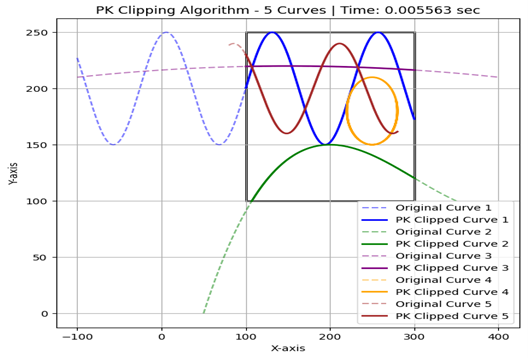
Main Results: The experimental results indicate that the proposed RNSCA effectively reduces unnecessary computational overhead, particularly for large-scale and curve-heavy datasets. For small datasets, traditional intersection-based algorithms demonstrate comparable or slightly faster performance due to lower overhead. However, as dataset size increases, RNSCA exhibits superior scalability by discarding irrelevant fragments early in the processing pipeline. In curve clipping experiments, the benefits are more pronounced, as RNSCA avoids repeated polynomial intersection evaluations and prunes a significant portion of irrelevant geometry during early subdivision stages. Across multiple test cases, the algorithm eliminated approximately 70–80% of unnecessary computations prior to deep refinement while maintaining visually consistent clipping results. Although the recursive approach may preserve very small boundary-adjacent fragments depending on the chosen subdivision parameter N, it avoids false-positive acceptance of outside geometry. The results demonstrate that RNSCA provides a flexible accuracy–performance trade-off that can be tuned for specific application requirements.
Conclusions: The Recursive N-Subdivision Clipping Algorithm represents a meaningful advancement in clipping methodologies by shifting the computational focus from intersection-centric processing to subdivision-based, outcode-driven classification. By generalizing subdivision to N segments and refining only ambiguous regions, the algorithm achieves improved scalability, reduced redundancy, and enhanced suitability for parallel processing. Its unified treatment of line and curve primitives simplifies clipping pipelines and reduces algorithmic complexity in curve-dominated workloads. While careful selection of the subdivision parameter N is required to balance precision and performance, the proposed approach complements classical algorithms rather than replacing them, offering distinct advantages in large-scale and real-time graphics environments.
Practical Application: The proposed RNSCA is particularly well suited for GPU-accelerated rendering pipelines, real-time visualization systems, CAD/CAM platforms, GIS applications, and vector graphics engines where large volumes of geometric primitives must be efficiently processed. By minimizing expensive intersection computations and enabling embarrassingly parallel execution, the algorithm reduces processing time, improves rendering throughput, and lowers computational overhead. Its adaptability allows developers and practitioners to tune precision based on application needs, making it beneficial for both interactive graphics and large-scale industrial visualization tasks. The algorithm thus offers tangible benefits to industry and research communities seeking scalable and future-ready geometric clipping solutions.
References
Cohen, D. and Sutherland, I.E. 1967. A method for line clipping. Proceedings of the AFIPS Spring Joint Computer Conference, 16, 343–351.
Liang, Y.-D. and Barsky, B.A. 1984. A new concept and method for line clipping. ACM Transactions on Graphics, 3, 1–22. https://doi.org/10.1145/357332.357333.
Nicholl, T., Lee, D. and Nicholl, M. 1987. An efficient new algorithm for 2-D line clipping. ACM SIGGRAPH Computer Graphics, 21, 253–262.
Foley, J.D., van Dam, A., Feiner, S.K. and Hughes, J.F. 1990. Computer Graphics: Principles and Practice. Addison-Wesley, MA.
Lou, Q. and Liu, L. 2012. Hybrid clipping for curve intersection. Computers & Graphics, 44, 753–766. https://doi.org/10.1016/j.cag.2012.03.021.
Rehman, S., Khan, S. and Khan, M. 2019. A survey of line clipping algorithms. IEEE Access, 7, 154876–154891. https://doi.org/10.1109/ACCESS.2019.2943889.
Schmalstieg, D., Höllerer, T., Diepstraten, J. and Fuhrmann, A. 2018. GPU-based hierarchical rasterization for vector graphics. ACM Transactions on Graphics, 37, Article 116. https://doi.org/10.1145/3197517.3201320.
Loop, C. and Blinn, J. 2005. Resolution independent curve rendering using programmable graphics hardware. ACM Transactions on Graphics, 24, 1000–1009. https://doi.org/10.1145/1073204.1073295.
Patrikalakis, N.M., Maekawa, T. and Sakkalis, G. 2009. Shape Interrogation for Computer Aided Design and Manufacturing. Springer-Verlag, Berlin.
Nießner, M., Zollhöfer, M., Izadi, S. and Stamminger, M. 2013. Real-time 3D reconstruction at scale using voxel hashing. ACM Transactions on Graphics, 3, Article 169. https://doi.org/10.1145/2508363.2508403
Liu, Y. and Puri, R. 2021. Large-scale GPU-accelerated spatial join processing. IEEE Transactions on Knowledge and Data Engineering, 33, 1112–1126. https://doi.org/10.1109/TKDE.2019.2941566
Matthes, F. and Drakopoulos, G. 2019. Fast line clipping against rectangular windows. Journal of Graphics Tools, 23, 1–14.
Skala, V. and Bùi, T. 2019. Efficient line clipping in E³. Computers & Graphics, 83, 1–11. https://doi.org/10.1016/j.cag.2019.04.001
Wonka, P., Ribarsky, W. and Eble, M.S. 2021. Visibility in computer graphics: a survey. IEEE Computer Graphics and Applications, 41, 42–58. https://doi.org/10.1109/MCG.2020.3040431
Amanatides, J. and Woo, A. 1987. A fast voxel traversal algorithm for ray tracing. Proceedings of the Eurographics Conference, 3–10.
Akenine-Möller, T., Haines, E. and Hoffman, N. 2018. Real-time Rendering. CRC Press, Boca Raton.
Pharr, M., Jakob, W. and Humphreys, G. 2016. Physically Based Rendering: From Theory to Implementation, Morgan Kaufmann.
Hormann, K. and Agathos, A. 2001. The point-in-polygon problem for arbitrary polygons. Computational Geometry: Theory and Applications, 20, 131–144. https://doi.org/10.1016/S0925-7721(01)00014-5
Liu, Y. and Puri, R. 2020. Filter-and-refine strategies for GPU-based geometric processing. Proceedings of the ACM SIGSPATIAL International Conference on Advances in Geographic Information Systems, 1–10.
Matthes, D. and Drakopoulos, V. 2022. Line clipping in 2D: overview, techniques and algorithms. Journal of Imaging, 8, 286.
Piegl, L. and Tiller, W. 1997. The NURBS Book. Springer-Verlag, Berlin.
Skala, V. 1995. Fast algorithms for line clipping. Computer Graphics Forum, 14, 21–34. https://doi.org/10.1111/1467-8659.1410021.
Cohen-Or, D. and Chrysanthou, Y.L. 2003. A survey of visibility for walkthrough applications. IEEE Transactions on Visualization & Computer Graphics, 9, 412-431.
Downloads
Published
How to Cite
Issue
Section
License
Copyright (c) 2026 King Mongkut's University of Technology Thonburi

This work is licensed under a Creative Commons Attribution-NonCommercial-NoDerivatives 4.0 International License.
Any form of contents contained in an article published in Science and Engineering Connect, including text, equations, formula, tables, figures and other forms of illustrations are copyrights of King Mongkut's University of Technology Thonburi. Reproduction of these contents in any format for commercial purpose requires a prior written consent of the Editor of the Journal.