
Solid-state Fermentation of Palm Kernel Cake Using Two Bacillus Strains in Co-culture for Probiotics Production
Keywords:
Solid-state Fermentation, Palm Kernel Cake, Probiotics, Protease Enzyme, Amylase EnzymeAbstract
Background and Objectives: Bacillus velezensis and Bacillus subtilis are bacteria commonly used as probiotic microorganisms in animal feed formulations due to their effectiveness in controlling and inhibiting pathogenic microbes. Additionally, they can produce beneficial enzymes that aid animal digestion, including proteases and amylases. Solid-state fermentation (SSF) is a widely adopted process for probiotics production and is also known to enhance the nutritional value of animal feed. However, previous studies have shown that using a single microbial strain in SSF often results in incomplete utilization of nutrients from raw materials at the end of the fermentation process. Therefore, two probiotic strains, B. velezensis and B. subtilis, were selected to enhance the efficiency of nutrient utilization from a raw material. This dual-strain approach is expected to improve probiotics production efficiency from agro-industrial by-products, specifically palm kernel cake, which is a residue from the palm oil production industry.
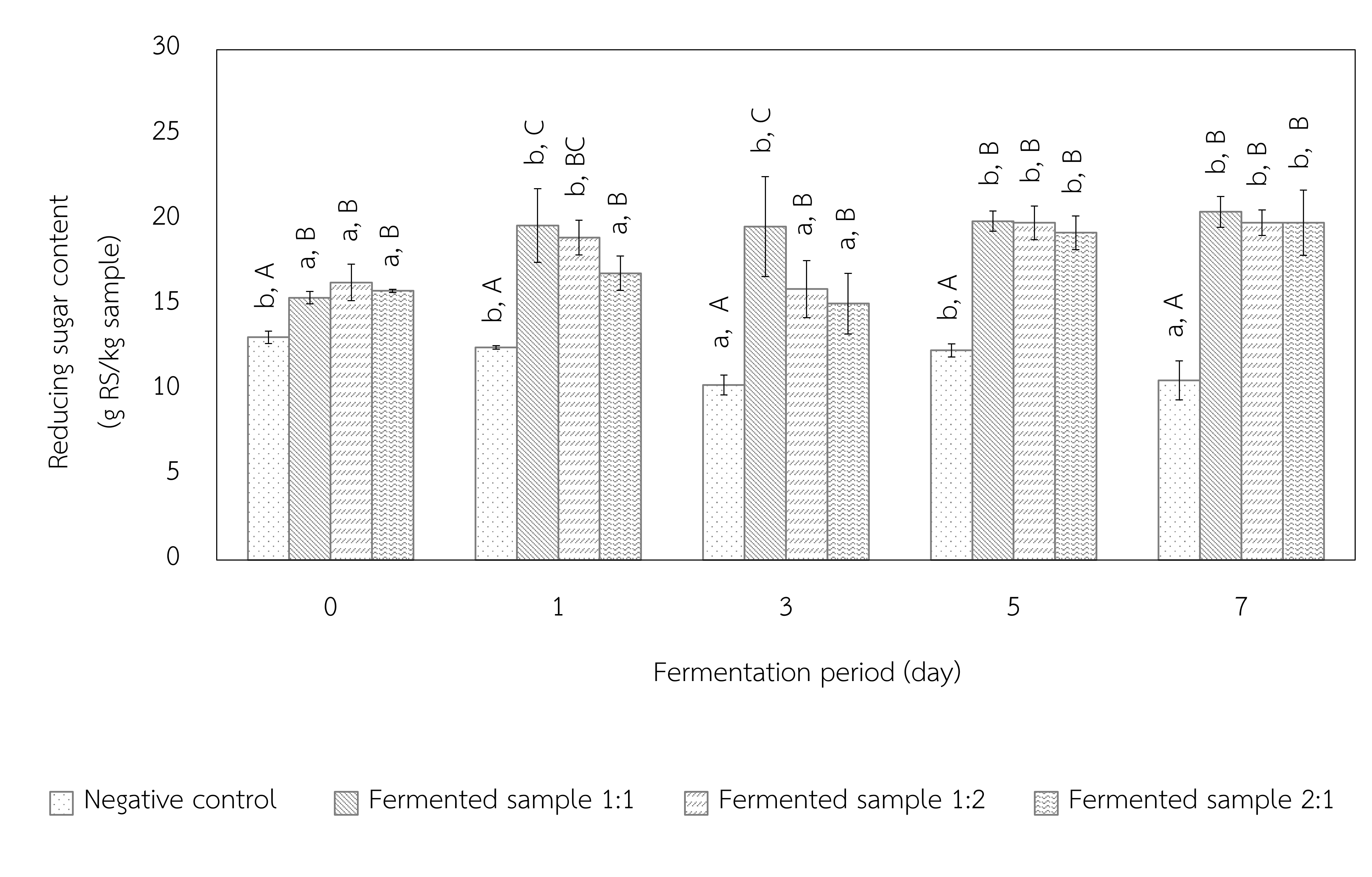
Methodology: This study employed SSF with B. velezensis and B. subtilis at the ratios of 1:1, 1:2, and 2:1 with palm kernel cake as the fermentation substrate. Fermentation was carried out over a period of 7 days at 37°C. Samples were collected on days 0, 1, 3, 5, and 7 for the analysis. Changes of various parameters were monitored throughout the fermentation period, including total viable count, soluble protein content, protease activity, amylase activity, reducing sugar content, moisture content and pH. The objective was to determine the optimal condition for probiotics production.
Main Results: The results of the study on the optimal ratio for fermenting palm kernel cake with B. velezensis and B. subtilis at ratios of 1:1, 1:2 and 2:1 reveal that the total viable microbial count reached its peak on day 3 for all tested ratios. Similarly, the protease and amylase enzyme activities in the fermented palm kernel cake reached their highest levels on day 3, corresponding with the peak in total viable microbial count. The samples with the ratios of 1:1 and 2:1 exhibited higher protease activity compared to the one with the ratio of 1:2; the 1:1 ratio showed the highest amylase activity among all the treatments.
Conclusions: Utilization of palm kernel cake as a substrate for SSF to produce probiotic microorganisms and to enhance nutritional value was investigated using two probiotic strains, B. velezensis and B. subtilis. A ratio of 1:1 was identified as the optimal condition at the laboratory scale.
Practical Application: The present findings can serve as a basis for scaling up the process to pilot-scale production and can be further developed into a commercial application.
References
Mingmongkolchai, S. and Panbangred, W. 2018. Bacillus probiotics: An alternative to antibiotics for livestock production. Journal of Applied Microbiology, 124, 1334-1346.
Tanpong, S., Khochamit, N., Pootthachaya, P., Siripornadulsil, W., Unnawong, N., Cherdthong, A., Tengjaroenkul, B. and Wongtangtintharn, S. 2024. Citric acid by-product fermentation by Bacillus subtilis I9: A promising path to sustainable animal feed. Veterinary Sciences, 11, 484.
Lee, J., Park, I., Choi, Y. and Cho, J. 2012. Bacillus strains as feed additives: In vitro evaluation of its potential probiotic properties. Revista Colombiana de Ciencias Pecuarias, 25, 577-585.
Bromfield, J.I., Niknafs, S., Chen, X., von Hellens, J., Horyanto, D., Sun, B., Yu, L., Tran, V.H., Navarro, M. and Roura, E. 2024. The evaluation of next-generation Probiotics on broiler growth performance, gut morphology, gut microbiome, nutrient digestibility, in addition to enzyme production of Bacillus spp. in vitro. Animal Nutrition, 18, 133-144.
Sousa, E.G., Campos, G.M., Quaresma, L.S., Mota, T.F.M., de Castilhos Ghisi, N., Gomes, G.C., Santos, R.C.V., de Souza, B.G.R., Guédon, E., de Castro Soares, S., Dutra, J.C.F. and de Carvalho Azevedo, V.A. 2025. Exploring Bacillus velezensis in a biomedical context: A systematic review. Academia Molecular Biology and Genomics, 2, 1-21.
Kapilan, R. 2015. Solid-state fermentation for microbial products: A review. Archives of Applied Science Research, 7, 21-25.
Trade Policy and Strategy Office, Guidelines for enhancing the trade potential of the palm oil industry [Online], Available: https://www.tpso.go.th/document/2409-0000000001. [8 September 2025]
Husin, A.H., Hamzani, S.H., Amirnordin, S.H., Batcha, M.F.M., Wahidon, R. and Wae-hayee, M. 2022. Drying studies of oil palm decanter cake for production of green fertilizer. Journal of Advanced Research in Fluid Mechanics and Thermal Sciences, 97, 66-79.
Mirnawati, M., Ciptaan, G. and Ferawati, F. 2019. Improving the quality and nutrient content of palm kernel cake through fermentation with Bacillus subtilis. Livestock Research for Rural Development, 31, 98.
Association of Official Analytical Chemists, 2012, Official Methods of Analysis, AOAC International, Gaithersburg.
Bradford, M.M., 1976, A rapid and sensitive method for the quantitation of microgram quantities of protein utilizing the principle of protein-dye binding. Analytical Biochemistry, 72, 248-254.
Boratyñski, F., Szczepañska, E., Grudniewska, A., GniÍka, R. and Olejniczak, T. 2018. Improving of hydrolases biosythesis by solid-state fermentation of Penicillium camemberti on rapeseed cake. Scientific Reports, 8, 10157.
Afrisham, S., Badoei-Dalfard, A., Namaki-Shoushtari, A. and Karami, Z., 2016, Characterization of a thermostable, CaCl2-activated and raw-starch hydrolyzing alpha-amylase from Bacillus licheniformis AT70: Production under solid-state fermentation by utilizing agricultural wastes. Journal of Molecular Catalysis B: Enzymatic, 32, 98-106.
Saqib, A.A.N. and Whitney, P.J. 2011. Differential behaviour of the Dinitrosalicylic acid (DNS) reagent towards mono- and di-saccharide sugars. Biomass and Bioenergy, 35, 4748-4750.
Zhang, Q., Kobras, C.M., Gebhard, S., Mascher, T. and Wolf, D. 2022. Regulation of heterologous subtilin production in Bacillus subtilis W168. Microbial Cell Factories, 21, 57.
Ministry of Agriculture and Cooperatives. 2016. Notification of the Ministry of Agriculture and Cooperatives on the specification of substances permitted in animal feed, their usage levels, and conditions prohibiting the production, import, or sale of animal feed, B.E. 2559 (2016), Government Gazette, Vol. 133, Special Issue 306 Ng.
Karataş, H., Uyar, F., Tolan, V. and Baysal, Z., 2013, Optimization and enhanced production of α-amylase and protease by a newly isolated Bacillus licheniformis ZB-05 under solid-state fermentation. Annals of Microbiology, 63, 45-52.
Sun, B., Zou, K., Zhao, Y., Tang, Y., Zhang, F., Chen, W., Tang, W., Chang, C. and Zheng, Y. 2023. The fermentation optimization for alkaline protease production by Bacillus subtilis BS-QR-052, Frontiers in Microbiology, 14, 1301065.
Zhu, X., Deng, Z., Wang, Q., Hao, S., Liu, P., He, S. and Li, X. 2024. Improvement in palm kernel meal quality by solid-sate fermentation with Bacillus velezensis, Saccharomyces cerevisiae and Lactobacillus paracasei. Fermentation, 10, 655.
Wang, J. and Fung, D.Y.C. 1996. Alkaline-fermented foods: A review with emphasis on pidan fermentation. Critical Reviews in Microbiology, 22, 101-138.
Downloads
Published
How to Cite
Issue
Section
License
Copyright (c) 2026 King Mongkut's University of Technology Thonburi

This work is licensed under a Creative Commons Attribution-NonCommercial-NoDerivatives 4.0 International License.
Any form of contents contained in an article published in Science and Engineering Connect, including text, equations, formula, tables, figures and other forms of illustrations are copyrights of King Mongkut's University of Technology Thonburi. Reproduction of these contents in any format for commercial purpose requires a prior written consent of the Editor of the Journal.