
Analysis of Factors Influencing Risk Behavior of Motorcyclists: A Case Study of Chiang Mai University Students
Keywords:
Motorcycle Riding Behavior, Theory of Planned Behavior, Perceived Behavioral Control, Structural Equation Modeling, Road SafetyAbstract
Background and Objectives: Thailand continues to face high rates of road accidents, particularly among young motorcycle users who are considered as risky and vulnerable road users. The present study focused on analyzing risky riding behaviors among students at Chiang Mai University by applying the Theory of Planned Behavior (TPB) integrated with Structural Equation Modeling (SEM). The main objective was to identify key psychological and behavioral factors influencing safe motorcycle riding, specifically Attitude (ATT), Subjective Norm (SJN), Perceived Behavioral Control (PBC), Intention (INT), and Behavior (BHV) to develop an evidence-based model for improving road safety among university students.
Methodology: The study employed a combined observational and survey study approach. Quantitative data were collected from 884 students through structured questionnaires measuring TPB constructs, while quantitative data were obtained from on-campus traffic video recordings to verify the observed behaviors. SEM was used to test causal relationships among latent variables (ATT, SJN, PBC, INT, and BHV). Reliability and validity were assessed through factor analysis.
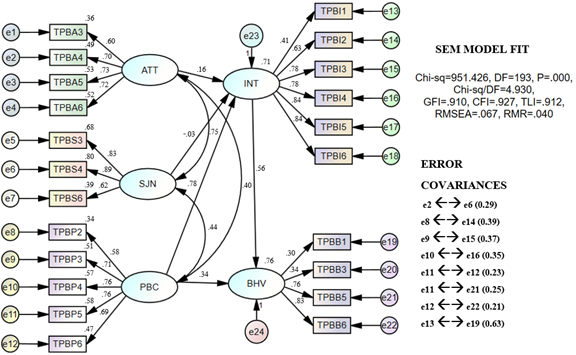
Main Results: The structural equation model exhibited an acceptable-to-good fit to the data (χ²/do = 4.93, CFI = 0.927, GFI = 0.910, TLI = 0.912, RMSEA = 0.067, RMR = 0.040). PBC had the strongest influence on both Intention (β = 0.78) and Behavior (β = 0.34), while Intention significantly mediated the relationship between PBC and safe riding behavior (β = 0.56). Attitude had a weaker impact on Intention (β = 0.16), while Subjective Norm showed no significant effect. Female and younger students (below 19) were more influenced by PBC, whereas male and older students’ behaviors were driven mainly by Intention.
Conclusions: The study concluded that PBC and Intention are the most critical determinants of safe motorcycle riding among university students. The findings suggest that improving riders’ self-efficacy, confidence, and skills is more effective than relying on social norms or peer pressure. This evidence supports using TPB as a robust framework for understanding and predicting safe riding intentions and behaviors.
Practical Application: Based on the results, a 3E-based systemic intervention—Education, Enforcement, and Engineering—under the Swiss Cheese Model is proposed to close risk gaps and strengthen road safety within the University. Practical measures include safety training programs, female rider confidence workshops, and a student reward system for safe riding behavior. These initiatives can serve as a prototype for a safe university campus.
References
Road Safety Academic Center (RSAC) and ThaiRSC Foundation. 2019. Revealing Perspectives of Vulnerable Road Users (VRUs) [Online]. Available: https://www.roadsafetythai.org/edoc/doc_20190805142128.pdf [10 May 2025] (In Thai)
World Health Organization (WHO). 2021. Decade of Action for Road Safety 2021–2030 [Online]. Available: https://www.who.int/teams/social-determinants-of-health/safety-and-mobility/decade-of-action-for-road-safety-2021-2030 [10 May 2025]
SDG Move. 2021. WHO Reveals Report: 'Thailand' Has Highest Road Fatalities in Southeast Asia Despite Good Traffic Laws [Online]. Available: https://www.sdgmove.com/2021/02/10/who-global-sttus-report-on-road-safety-2018/ [10 May 2025] (In Thai)
Thailand Development Research Institute (TDRI). 2024. Reviewing Statistics on Injuries and Deaths on Thai Roads 2021–2023, Moving Towards the Goal of Reducing Fatalities Before 2027 [Online]. Available: https://tdri.or.th/road-safety/ [10 May 2025] (In Thai)
Chang, H.-L. and Yeh, T.-H. 2006. Risk factors to driver fatalities in single-vehicle crashes: comparisons between non-motorcycle drivers and motorcyclists. Journal of Transportation Engineering, 132, 227–236. https://doi.org/10.1061/(ASCE)0733-947X(2006)132:3(227)
Lawton, R., Parker, D., Manstead, A.S. and Stradling, S.G. 1997. The role of affect in predicting social behaviors: the case of road traffic violations. Journal of Applied Social Psychology, 27, 1258–1276. https://doi.org/10.1111/j.1559-1816.1997.tb01805.x
Department of Disease Control. 2020. Stop!! Thai Children and Youth Dying from Road Traffic Accidents. Bureau of Non-Communicable Disease, Ministry of Public Health, Nonthaburi. (In Thai)
Reason, J. 1990. Human Error. Cambridge University Press, Cambridge.
Department of Land Transport. 2021. Analysis Report of Road Traffic Accident Statistical Data for Fiscal Year 2021 [Online]. Available: http://www.dlt.go.th [10 May 2025] (In Thai)
SCMC. 2025. Accident Dashboard: Road Traffic Accidents [Online]. Available: https://public.tableau.com/app/profile/scmc/viz/Accident_17206129265280/Accident [15 May 2025]
Ajzen, I. 1991. The theory of planned behavior. Organizational Behavior and Human Decision Processes, 50, 179–211. https://doi.org/10.1016/0749-5978(91)90020-T
Somoray, K., White, K.M., Watson, B. and Lewis, I. 2024. Predicting risky driving behaviours using the theory of planned behaviour: a meta-analysis. Accident Analysis and Prevention, 208, 107797. https://doi.org/10.1016/j.aap.2024.107797
Elliott, M.A., Armitage, C.J. and Baughan, C.J. 2011. Using the theory of planned behaviour to predict observed driving behaviour. British Journal of Social Psychology, 46, 69–90. https://doi.org/10.1348/014466605X90801
Paris, H. and Van den Broucke, S. 2008. Measuring cognitive determinants of speeding: an application of the theory of planned behaviour. Transportation Research Part F: Traffic Psychology and Behaviour, 11, 168–180. https://doi.org/10.1016/j.trf.2007.09.002
A Armitage, C.J., Norman, P. and Conner, M. 2010. Can the theory of planned behaviour mediate the effects of age, gender and multidimensional health locus of control?. British Journal of Health Psychology, 7, 299–316. https://doi.org/10.1348/135910702760213698
Yang, H., Liu, X., Su, F. and Cherry, C. 2018. Predicting e-bike users’ intention to run the red light: an application and extension of the theory of planned behavior. Transportation Research Part F: Traffic Psychology and Behaviour, 58, 282–291. https://doi.org/10.1016/j.trf.2018.05.027
Rezapur-Shahkolai, F., Vesali-Monfared, E., Barati, M. and Tapak, L. 2022. Prediction of helmet use behavior among motorcyclists based on the theory of planned behavior. Journal of Research in Health Sciences, 22, e00564. https://doi.org/10.34172/jrhs.2022.99
Forward, S.E. 2009. The theory of planned behaviour: the role of descriptive norms and past behaviour in the prediction of drivers’ intentions to violate. Transportation Research Part F: Traffic Psychology and Behaviour, 12, 198–207. https://doi.org/10.1016/j.trf.2008.12.002
Tiyabutr, T., Satiennam, W. and Satiennam, T. 2015. Application of the theory of planned behavior (TPB) to study the factors effect to motorcyclist’s intention to run red light. The 20th National Convention on Civil Engineering, Chonburi, Thailand.
Francis, J., Eccles, M.P., Johnston, M., Walker, A., Grimshaw, J., Foy, R., Kaner, E.F.S., Smith, L. and Bonetti, D. 2004. Constructing Questionnaires Based on the Theory of Planned Behaviour: A Manual for Health Services Researchers. Centre for Health Services Research, University of Newcastle, Newcastle upon Tyne, United Kingdom.
Zhou, R., Rau, P.P., Zhang, W. and Zhuang, D. 2012. Mobile phone use while driving: predicting drivers' answering intentions and compensatory decisions. Safety Science, 50, 138–149. https://doi.org/10.1016/j.ssci.2011.07.013
Özkan, T., Lajunen, T., Doğruyol, B., Yıldırım, Z. and Çoymak, A. 2012. Motorcycle accidents, rider behaviour, and psychological models. Accident Analysis and Prevention, 49, 124–132. https://doi.org/10.1016/j.aap.2011.03.009
Parker, D., Manstead, A.S.R., Stradling, S.G., Reason, J.T. and Baxter, J.S. 1992. Intention to commit driving violations: an application of the theory of planned behavior. Journal of Applied Psychology, 77, 94–101. https://doi.org/10.1037/0021-9010.77.1.94
Evans, D. and Norman, P. 1998. Understanding cycling behaviour: an application of the theory of planned behaviour. Health Education Research, 13, 117–127.
Armitage, C.J. and Conner, M. 2010. Efficacy of the theory of planned behaviour: a meta-analytic review. British Journal of Social Psychology, 40, 471–499. https://doi.org/10.1348/014466601164939
Cristea, M. and Gheorghiu, A. 2016. Attitude, perceived behavioral control, and intention to adopt risky behaviors. Transportation Research Part F: Traffic Psychology and Behaviour, 43, 157–165. https://doi.org/10.1016/j.trf.2016.10.004
Orzanna, R. 2015. Image Description [Online]. Available: https://commons.wikimedia.org/w/index.php?curid=42261999 [14 April 2025]
Wang, X. and Xu, L. 2021. Factors influencing young drivers' willingness to engage in risky driving behavior: Continuous lane-changing. Sustainability, 13, 6459. https://doi.org/10.3390/su13116459
Qin, L. and Ma, X. 2023. Analysis of factors influencing aberrant riding behavior of electric bicycle riders based on the theory of planned behavior. IATSS Research, 47, 466–474.
Hassan, H.M. and Shawky, M. 2023. Exploring the factors influencing risky driving behavior using the theory of planned behavior and the role of moral norm. Behavioral Sciences, 13, 309.
Zhao, N., Meitner, M.J. and Fu, L. 2019. The application and extension of the theory of planned behavior to predict pedestrians’ violating crossing behavior in China. Accident Analysis and Prevention, 124, 127–135.
Lee, T.K. and Kim, J.T. 2015. Residents' responses on indoor environment quality and energy use in apartments. Energy and Buildings, 98, 34–38. https://doi.org/10.1016/j.enbuild.2014.10.084
Kursunoglu, N. and Onder, M. 2019. Application of structural equation modeling to evaluate coal and gas outbursts. Tunnelling and Underground Space Technology, 88, 63–72. https://doi.org/10.1016/j.tust.2019.02.017
Reason, J. 1997. Managing the Risks of Organizational Accidents. Ashgate, Aldershot.
Reason, J. 2000. Human error: Models and management. BMJ, 320, 768–770. https://doi.org/10.1136/bmj.320.7237.768
OECD/ITF. 2008. Towards Zero: Ambitious Road Safety Targets and the Safe System Approach. OECD Publishing, Paris.
World Health Organization. 2018. Global Status Report on Road Safety 2018. WHO Press.
Hair, J.F., Black, W.C., Babin, B.J. and Anderson, R.E. 2019. Multivariate Data Analysis, Cengage Learning, Boston.
Hair, J.F., Black, W.C., Babin, B.J. and Anderson, R.E. 2010. Multivariate Data Analysis, Pearson Prentice Hall International, New York.
Baumgartner, H. and Homburg, C. 1996. Applications of structural equation modeling in marketing and consumer research: A review. International Journal of Research in Marketing, 13, 139–161. https://doi.org/10.1016/0167-8116(95)00038-0
Doll, W.J., Xia, W. and Torkzadeh, G. 1994. A confirmatory factor analysis of the end-user computing satisfaction instrument. MIS Quarterly, 18, 453–461. https://doi.org/10.2307/249524
Hooper, D., Coughlan, J. and Mullen, M.R. 2008. Structural equation modelling: guidelines for determining model fit. Electronic Journal of Business Research Methods, 6, 53–60
Miles, J. and Shevlin, M. 1998. Effects of sample size, model specification and factor loadings on the GFI in confirmatory factor analysis. Personality and Individual Differences, 25, 85–90. https://doi.org/10.1016/S0191-8869(98)00055-5
Brown, T.A. 2015. Confirmatory Factor Analysis for Applied Research. Guilford Press, New York.
Browne, M.W. and Cudeck, R. 1993. Alternative ways of assessing model fit (pp. 136–162), in K.A. Bollen and J.S. Long (Eds.) Testing Structural Equation Models, Sage Publications, Newbury Park.
Schermelleh-Engel, K., Moosbrugger, H. and Müller, H. 2003. Evaluating the fit of structural equation models: Tests of significance and descriptive goodness-of-fit measures. MPR-Online, 8, 23–74.
Downloads
Published
How to Cite
Issue
Section
License
Copyright (c) 2026 King Mongkut's University of Technology Thonburi

This work is licensed under a Creative Commons Attribution-NonCommercial-NoDerivatives 4.0 International License.
Any form of contents contained in an article published in Science and Engineering Connect, including text, equations, formula, tables, figures and other forms of illustrations are copyrights of King Mongkut's University of Technology Thonburi. Reproduction of these contents in any format for commercial purpose requires a prior written consent of the Editor of the Journal.