Navigating the Transition to Industry 5.0: Risk and Resilience in Technology Startups
Keywords:
Technology Startups, Industry 5.0, Risk Management, Human-centric Innovation, ResilienceAbstract
Background and Objectives: The rapid advancement of digital technologies has driven Industry 4.0, yet emerging research emphasizes a shift toward Industry 5.0, which prioritizes human-centric, sustainable, and resilient innovation. Despite the growing importance of this transition, there is limited understanding of how early-stage technology startups manage risks while aligning with these Industry 5.0 principles, particularly in emerging economies. This study aims to examine how Thai technology startups perceive and navigate risks associated with product development, market adoption, and ecosystem dependencies in the context of Industry 5.0.
Methodology: A qualitative multiple-case study design was employed to explore these issues in depth. Seven early-stage technology startups across diverse sectors, including education, healthcare, construction, and alternative medicine, were purposively selected to ensure variation in digital platforms and technology-based products. Semi-structured interviews were conducted with founders or co-founders, focusing on entrepreneurial motivations, business development processes, perceived risks, adaptation strategies, and ecosystem support. The interview data were analyzed using thematic coding, which involved initial coding to identify recurring challenges and risk factors, axial coding to group codes into broader themes, and interpretive analysis to align findings with the emerging Industry 5.0 framework. Themes were validated through cross-checking by multiple researchers and iterative comparison across cases.
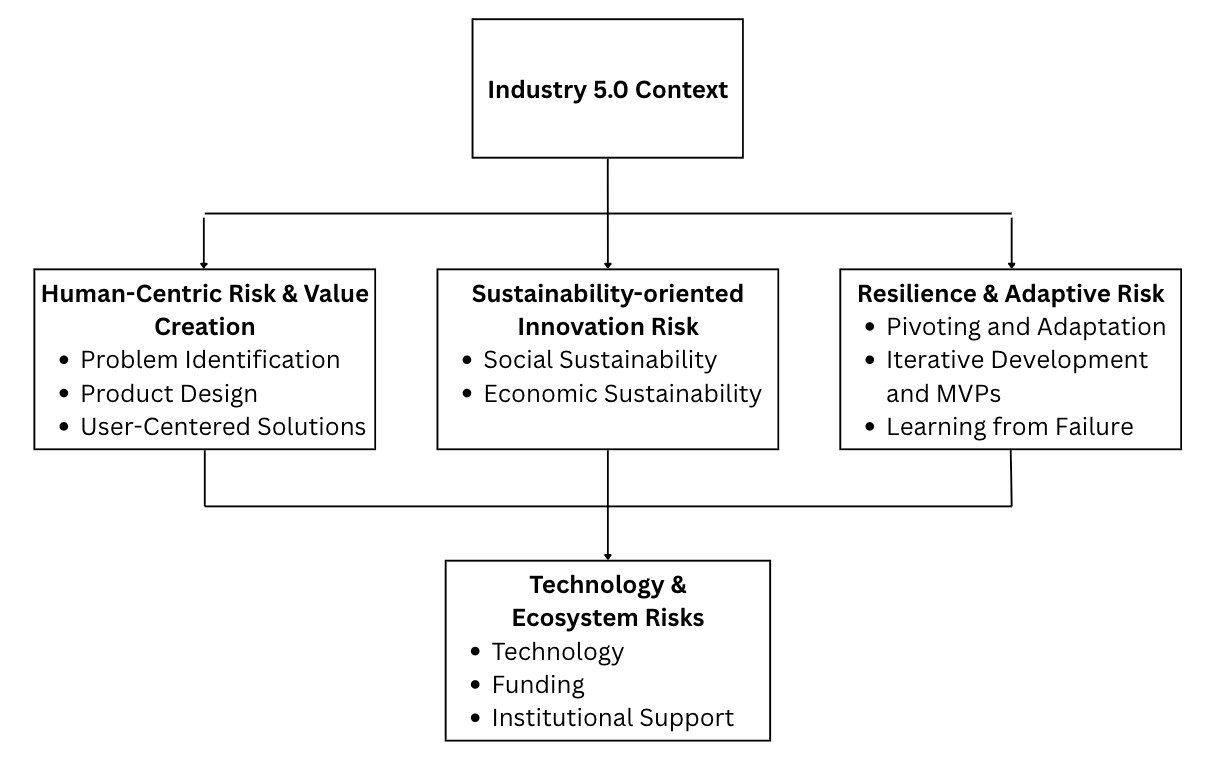
Main Results: The findings reveal that startups integrate human-centric design, sustainability-oriented innovation, and resilience-building strategies to navigate uncertainty, while simultaneously confronting technology and ecosystem-related risks. Human-centric approaches allow startups to align their offerings with real user needs, often informed by the founders’ personal experiences and iterative feedback from target users. Sustainability considerations, including social and economic dimensions, contribute to long-term viability by supporting small businesses, promoting equitable access, and addressing societal challenges. Resilience mechanisms, such as pivoting, minimum viable product testing, and learning from failure, enhance startups’ adaptive capacity and ability to respond to environmental shocks. Technology-related risks, particularly the recruitment and management of skilled technical talent, along with limitations in funding and mentorship, were identified as critical ecosystem vulnerabilities. Access to incubator support, structured mentorship, and institutional resources played a central role in mitigating these risks and enabling startup survival.
Conclusions: These findings contribute to entrepreneurship and innovation literature by demonstrating that Industry 5.0 provides a comprehensive framework for understanding startup risk management that extends beyond purely technical and financial dimensions. The study highlights the importance of integrating human-centricity, sustainability, and resilience in entrepreneurial practice, while also emphasizing the role of ecosystem support in emerging economies.
Practical Application: The insights offer practical implications for entrepreneurs, incubators, and policymakers seeking to foster sustainable and resilient startup ecosystems, suggesting that targeted support mechanisms, combined with iterative and adaptive innovation strategies, can enhance both startup performance and societal impact.
This article has a related Erratum. 🔗
References
Autio, E., Nambisan, S., Thomas, L.D. and Wright, M. 2018. Digital affordances, spatial affordances, and the genesis of entrepreneurial ecosystems. Strategic Entrepreneurship Journal, 12, 72-95.
Intarakumnerd, P. 2019. Thailand’s middle-income trap: Firms’ technological upgrading and innovation and government policies. Seoul Journal of Economics, 32, 107-135.
Jirapong, K., Cagarman, K. and von Arnim, L. 2021. Road to sustainability: University–start-up collaboration. Sustainability, 13, 6131.
Moeuf, A., Pellerin, R., Lamouri, S., Tamayo-Giraldo, S. and Barbaray, R. 2018. The industrial management of SMEs in the era of Industry 4.0. International Journal of Production Research, 56, 1118-1136.
Fukuyama, M. 2018. Society 5.0: Aiming for a new human-centered society. Japan Spotlight, 27, 47-50.
Boonmee, C., Mangkalakeeree, J. and Jeong, Y. 2025. Towards sustainable digital transformation: AI adoption barriers and enablers among SMEs in Northern Thailand. Sustainable Futures, 10, 101169.
Piyatamrong, T. and Guile, D. 2024. Cultivating Workplace Innovation: Establishing a Common Technical Language for Knowledge Management in a Digital Transformation Perspective-A UK-Based Global Consulting Firm Case Study. 2024 IEEE International Conference on Technology Management, Operations and Decisions (ICTMOD), IEEE, Sharjah, United Arab Emirates. https://doi.org/10.1109/ICTMOD63116.2024.10878215.
Stinchcombe, A.L. 2013. Social structure and organizations 1, in Handbook of organizations (RLE: Organizations). Routledge, 142-193.
Song, M., Podoynitsyna, K., Van Der Bij, H. and Halman, J.I. 2008. Success factors in new ventures: A meta‐analysis. Journal of Product Innovation Management, 25, 7-27.
Cassar, G. 2004. The financing of business start-ups. Journal of Business Venturing, 19, 261-283.
Cantamessa, M., Gatteschi, V., Perboli, G. and Rosano, M. 2018. Startups’ roads to failure. Sustainability, 10, 2346.
Klotz, A.C., Hmieleski, K.M., Bradley, B.H. and Busenitz, L.W. 2014. New venture teams: A review of the literature and roadmap for future research. Journal of Management, 40, 226-255.
Bruton, G.D., Ahlstrom, D. and Obloj, K. 2008. Entrepreneurship in emerging economies: Where are we today and where should the research go in the future. Entrepreneurship Theory and Practice, 32, 1-14.
Opassuwan, T. and Mongkolkittaveepol, P. 2023. Enhancing a Firm's Innovation Performance: On the Interplay between Internal R&D and External Collaboration. Proceedings of the 2023 5th International Conference on Management Science and Industrial Engineering, Chiang Mai, Thailand, 348–352. ACM. https://doi.org/10.1145/3603955.3604286.
Phongthiya, T., Malik, K., Niesten, E. and Anantana, T. 2022. Innovation intermediaries for university-industry R&D collaboration: Evidence from science parks in Thailand. The Journal of Technology Transfer, 47, 1885-1920.
Frank, A.G., Dalenogare, L.S. and Ayala, N.F. 2019. Industry 4.0 technologies: Implementation patterns in manufacturing companies. International Journal of Production Economics, 210, 15-26.
Pustovrh, A., Rangus, K. and Drnovšek, M. 2020. The role of open innovation in developing an entrepreneurial support ecosystem. Technological Forecasting and Social Change, 152, 119892.
Nahavandi, S. 2019. Industry 5.0-A human-centric solution. Sustainability, 11, 4371.
Williams, T.A., Gruber, D.A., Sutcliffe, K.M., Shepherd, D.A. and Zhao, E.Y. 2017. Organizational response to adversity: Fusing crisis management and resilience research streams. Academy of Management Annals, 11, 733-769.
Teece, D., Peteraf, M. and Leih, S. 2016. Dynamic capabilities and organizational agility: Risk, uncertainty, and strategy in the innovation economy. California Management Review, 58, 13-35.
Jones, C., and Pimdee, P. 2017. Innovative ideas: Thailand 4.0 and the fourth industrial revolution. Asian International Journal of Social Sciences, 17, 4-35.
Yin, R.K. 2018. Case Study Research and Applications (Vol. 6). Sage Publications, California.
Eisenhardt, K.M. 1989. Building theories from case study research. Academy of Management Review, 14, 532-550.
Braun, V. and Clarke, V. 2006. Using thematic analysis in psychology. Qualitative Research in Psychology, 3, 77-101.
Downloads
Published
How to Cite
Issue
Section
License
Copyright (c) 2025 King Mongkut's University of Technology Thonburi

This work is licensed under a Creative Commons Attribution-NonCommercial-NoDerivatives 4.0 International License.
Any form of contents contained in an article published in Science and Engineering Connect, including text, equations, formula, tables, figures and other forms of illustrations are copyrights of King Mongkut's University of Technology Thonburi. Reproduction of these contents in any format for commercial purpose requires a prior written consent of the Editor of the Journal.