PM2.5 Emission Inventory of Urban Areas in Nakhonchaiburin Provincial Cluster
Keywords:
Emission Inventory, PM2.5, Particulate Matter, Air Quality, Air Pollution SourceAbstract
Background and Objectives: Particulate matter smaller than 2.5 microns (PM2.5) is a major problem in the country, having adverse effects on public health and causing much concern to all parties. Although some local areas have not yet encountered the problem, as the economy develops, they may eventually face air quality issues. Therefore, building the capacity to cope with the PM2.5 problem for the public and local agencies, such as municipalities and towns, is important and necessary for their operations and to prevent the problem from increasing in the future. The present research aimed to create an inventory of PM2.5 sources and emissions of urban areas in the Nakhonchaiburin provincial cluster, namely, Nakhon Ratchasima Municipality, Chaiyaphum Municipality, Buriram Municipality, and Surin Municipality, and to study and compare the proportion of PM2.5 emissions between sources, as well as spatial analysis by creating PM2.5 emission maps of the study areas.
Methodology: The methodology consisted of reviewing relevant studies and selecting significant sources, which were divided into 3 main groups: (1) point type, including industrial plants, temples, and large establishments; (2) mobile type, including road transport and rail transport; and (3) area type, including residences and commercial buildings, markets, and agricultural areas. Then, data on sources were collected through field surveys, questionnaire data collection, contacting agencies for information, and traffic volume surveys. Emissions were estimated using the emission factor method, with the base year set to be 2023.
Main Results: Road transport group was the most important source of PM2.5 emissions in all study areas, accounting for more than half of all sources, or 51-61 percent. The second most significant source in all areas was the residential and commercial group, accounting for 19-33 percent. The third most significant source was the industrial factory group in 3 areas, except for Chaiyaphum Municipality, which is an agricultural area group. The sources that contributed the least to PM2.5 emissions in all areas were temples, large businesses, rail travel, and markets. When considering the pollutant emission rate per unit area, it was found that Buriram Municipality, which has the smallest area of only 6 sq.km, exhibited the highest pollutant emission rate per area, at 2,384 kg/sq.km/year, while Nakhon Ratchasima Municipality had a slightly lower pollutant emission rate per area at 2,239 kg/sq.km/year. Surin and Chaiyaphum municipalities ranked 3rd and 4th with values of 1,725 kg/sq.km/year and 1,004 kg/sq.km/year, respectively. The pollutant emission rate per capita, ranked from the highest to the lowest, was Chaiyaphum, Nakhon Ratchasima, Buriram, and Surin municipalities with values of 0.84, 0.72, 0.61, and 0.53 kg/person/year, respectively.
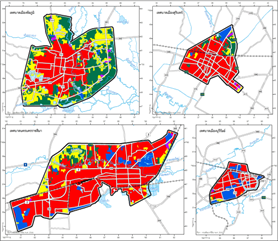
Conclusions: The main sources of PM2.5 emission were the road transport group, the residential and commercial group, and the industrial group. The emission rate per unit area was in the range of 1,004 - 2,384 kg/sq.km/year. The emission rate per population was in the range of 0.53 - 0.84 kg/person/year. The results of the spatial emission analysis for large municipalities clearly show that higher emission areas were along the main roads.
Practical Application: Results are useful for the four municipalities, government agencies involved in air quality management, public health agencies, academics, and the general public. Knowing the pollutant main sources and emission rates would lead to effective measures to reduce emissions and solve PM2.5 problem in the study areas.
References
Pope, C.A., III, Burnett, R.T., Thun, M.J., Calle, E.E., Krewski, D., Ito, K. and Thurston, G.D. 2002. Lung Cancer, Cardiopulmonary mortality, and long-term exposure to fine particulate air pollution. The Journal of the American Medical Association (JAMA), 287, 1132–1141.
Kim, K.H., Kabir, E. and Kabir, S. 2015. A review on the human health impact of airborne particulate matter. Environment International, 74, 136–143.
Genc, S., Zadeoglulari, Z., Fuss, S.H. and Genc, K. 2012. Air pollution and brain Health: An emerging issue. International Journal of Neuroscience, 122, 553–561.
Health Effects Institute. 2024. State of global air 2024. Special Report, Boston, Massachusetts, 15.
Pollution Control Department. 2025. Thailand State of Pollution Report 2024. Ministry of Natural Resources and Environment, Bangkok. (In Thai)
Ministry of Public Health. 2020. Medical and Public Health Operation Manual: Case of PM2.5 Year 2021. Department of Health, Ministry of Public Health, Bangkok. (In Thai)
Thai Health Watch Workgroup. 2022. Thai Health Watch 2022. Thai Health Promotion Foundation, Bangkok. (In Thai)
Kanabkaew, T. 2024. Thailand and overcoming the PM2.5 crisis. Journal of Multidisciplinary Academic Research and Development (JMARD), 6, 1–9. (In Thai)
Karuchit, S. 2022. PM2.5 Data Communication and Roles of Associated Stakeholders, A Knowledge Series of Air Pollution Prevention and Solutions. Center of Clean Air Solutions, Environmental Engineering Association of Thailand, Bangkok. (In Thai)
Pollution Control Department. 2019. Action Plan to Drive the National Agenda: Solving Air Pollution Problems. Ministry of Natural Resources and Environment, Bangkok. (In Thai)
Pollution Control Department. 2020. Operational Manual for Prevention and Mitigation of PM2.5 in Provincial Areas. Ministry of Natural Resources and Environment, Bangkok. (In Thai)
Pongprueksa, P. 2022. Guidelines for Controlling Emissions Using an Emission Inventory and Receptor Modeling, A Knowledge Series of Air Pollution Prevention and Solutions. Center of Clean Air Solutions, Environmental Engineering Association of Thailand, Bangkok. (In Thai)
Karuchit, S., Yotsoongnoen, K., Ounhavaidaya, P. and Saeheng, P. 2023. Impact of the new PM2.5 standard on indicators of the dust problem situation. The 35th Annual Environmental Technology Academic Conference, Environmental Engineering Association of Thailand, 1-9. (In Thai)
Cornet, B. and Bang, Q.H. 2017. Air emission inventory for smaller cities in ASEAN region: Findings and sensitivities. Air Qual Atmos Health, 10, 897-906.
Thailand Institute of Scientific and Technological Research. 2021. Air Pollution Survey, Source Apportionment of Particulate Matter: A Case Study of the Area around the North Bangkok Power Plant, Final Report. Thailand Institute of Scientific and Technological Research, Bangkok. (In Thai)
Suranaree University of Technology. 2012. Emission Inventory of Major Air Pollutants in Nakhon Ratchasima Municipality (NRM), Clean Air for Smaller Cities in the ASEAN Region Project by GIZ. Suranaree University of Technology, Nakhon Ratchasima.
Air Pollution Measurement, Evaluation and Monitoring Group. 2012. Chiang Mai Municipality Atmospheric Emission Inventory 2012, Clean Air for Smaller Cities in the ASEAN Region Project by GIZ. Chiang Mai University, Chiang Mai.
European Environment Agency. EMEP/EEA Air Pollutant Emission Inventory Guidebook 2019: Technical Guidance to Prepare National Emission Inventories [Online]. Available: https:// www.eea.europa.eu/publications/emep-eea-guidebook-2019. [12 January 2025]
U.S. EPA, Compilation of Air Pollutant Emissions Factors from Stationary Sources (AP-42), [Online], Available: https://www.epa.gov/air-emissions-factors-and-quantification/ap-42-compilation-air-emissions-factors-stationary-sources.
Asian Institute of Technology. 2020. Study on the Sources of PM2.5 and Precursors of Secondary PM2.5 in Bangkok Metropolitan Region. Asian Institute of Technology, Pathum Thani. (In Thai)
South Coast Air Quality Management District. 2022. Draft Final 2022 Air Quality Management Plan - Appendix III: Base and Future Year Emission Inventory. South Coast AQMD Print Shop, Diamond Bar, California.
Greater London Authority. London Atmospheric Emissions Inventory (LAEI) 2019 [Online]. Available: https://data.london.gov.uk/dataset/london-atmospheric-emissions-inventory-laei-2019-e758q/. [19 October 2025]
An, J., Huang, Y., Huang, C., Wang, X., Yan, R., Wang, Q., Wang, H., Jing, S., Zhang, Y., Liu, Y., Chen, Y., Xu, C., Qiao, L., Zhou, M., Zhu, S., Hu, Q., Lu, J. and Chen, C. 2021. Emission inventory of air pollutants and chemical speciation for specific anthropogenic sources based on local measurements in the Yangtze River Delta Region, China. Atmospheric Chemistry and Physics, 21, 2003-2025.
Sun, X., Cheng, S., Lang, J., Ren, Z. and Sun, C. 2018. Development of emissions inventory and identification of sources for priority control in the middle reaches of Yangtze River Urban agglomerations. Science of The Total Environment, 625, 155-167.
Fu, X., Wang, S., Zhao, B., Xing, J., Cheng, Z., Liu, H. and Hao, J. 2013. Emission inventory of primary pollutants and chemical speciation in 2010 for the Yangtze River Delta Region, China. Atmospheric Environment, 70, 39-50.
Downloads
Additional Files
Published
How to Cite
Issue
Section
License
Copyright (c) 2025 King Mongkut's University of Technology Thonburi

This work is licensed under a Creative Commons Attribution-NonCommercial-NoDerivatives 4.0 International License.
Any form of contents contained in an article published in Science and Engineering Connect, including text, equations, formula, tables, figures and other forms of illustrations are copyrights of King Mongkut's University of Technology Thonburi. Reproduction of these contents in any format for commercial purpose requires a prior written consent of the Editor of the Journal.